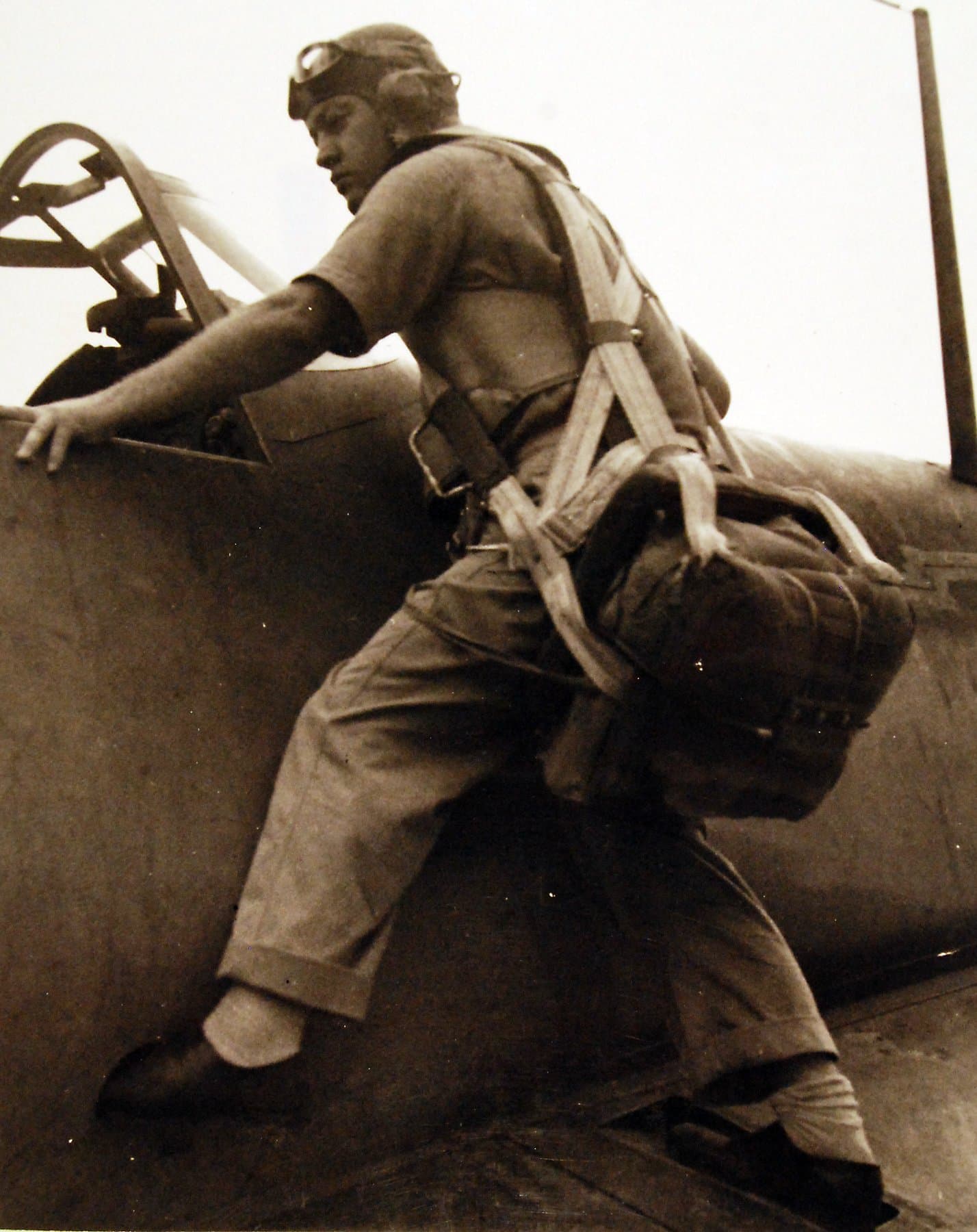
Lulubelle
F4U-1A Corsair · White 86
The Corsair in Pappy Boyington's most famous photo carried a woman's name and twenty victory flags. The records say he never flew it in combat, and the name was not Lulubelle.
The photograph that made the airplane famous was taken on the ground. In late November 1943, Maj. Gregory Boyington sat in the cockpit of a Vought F4U-1A Corsair marked with a white 86 on its fuselage, his elbow on the canopy rail, for the press. Below the cockpit a row of Japanese flags stood for his claims: twenty of them, six from his months with the Flying Tigers in Burma and fourteen from his first tour with Marine Fighting Squadron 214. Forward of the flags, on the nose, was a woman's name. In the best-known print a bystander's arm covers two of its letters. It reads "Lu**belle."
For the next thirty years, the world filled in the blanks the way Boyington told it to. Lulubelle. It went on air show posters and model kit boxes, on restored Corsairs and on the television show that made his squadron a household name. Boyington signed his name under it.
The evidence says the name was something else. The evidence also says Boyington never flew that airplane in combat.
The squadron he took over in August 1943 was not a collection of misfits, whatever the television version later claimed. VMF-214 had been commissioned in Hawaii in July 1942 as the Swashbucklers. When its first combat tour ended, the Marine Corps rebuilt it around a new commanding officer and a roster of replacement and pool pilots, many of them experienced. Boyington was about ten years older than most of the men he led, and they called him Gramps. The newspapers later made it Pappy. The squadron wanted to call itself Boyington's Bastards. The press would not print the word. On September 14, 1943, the pilots settled on the Black Sheep.
The airplane they flew was the strangest-looking fighter in the Pacific. Vought had built it around the most powerful engine it could get, the eighteen-cylinder Pratt & Whitney R-2800 Double Wasp, and to turn that power into thrust it needed a three-bladed propeller thirteen feet four inches across. A propeller that size needed ground clearance. Conventional landing gear tall enough to give it would have been long, heavy and weak on a carrier deck. Vought's answer was to bend the wing. The inner panels angled down from the fuselage and the outer panels angled back up, an inverted gull wing that let the landing gear be short and stout and put the wing root at a right angle to the fuselage, where it made less drag.
It was fast. On October 1, 1940, the prototype XF4U-1 flew from Stratford to Hartford, Connecticut, at more than 400 miles per hour, the first American single-engine fighter to do it. It was also hard to land. The long nose sat so far ahead of the cockpit that a pilot on final approach could not see the deck, and the Navy's early experience with the type earned it the name Ensign Eliminator. The Navy held it back from carriers. The Marines took it to land bases in the Solomons, and in February 1943 VMF-124 flew it into combat for the first time.
The pilots had their own names for it: the bent-wing bird, the hose nose. The name that stuck in print was Whistling Death. The standard explanation is that air rushing through the intakes in the inboard leading edges of the wings, the openings that fed the oil coolers and the supercharger, made a rising whistle in a dive, and that Japanese soldiers on the ground gave the airplane its name because of it. Museums repeat it. No Japanese source for the name has ever been found. The earliest known use of it for the Corsair appears in an American magazine, Time, in October 1943, and the phrase had been attached to artillery shells and to other American aircraft before that. The whistle was real. Who first called it death is an open question.
What mattered to the Black Sheep was that there were never enough airplanes. The squadron did not assign a Corsair to each pilot. Men flew whatever the ground crews had ready that morning, and the records show Boyington in at least four different airframes in November and December 1943. The Corsair wearing 86 and the twenty flags was one of them. Researchers who have traced the photographs and the squadron's aircraft records agree on what it was used for: publicity. Its flags were applied in a hurry for the camera. Several are mismatched. At least one is painted backwards. No surviving record puts Boyington in that airplane on a combat mission.
Then there is the name. Frank Walton, the squadron's intelligence officer, lived with the Black Sheep, wrote their combat reports and later wrote their history, Once They Were Eagles. He remembered the airplane as Lucybelle. A later photograph of the same Corsair, taken with another pilot, Jim Hill, in the cockpit, shows the name on the nose clearly enough to read. It is Lucybelle.
Lucy was Lucy Malcolmson, a former showgirl Boyington met aboard the transport SS Brazil in 1942, when he was on his way home from the Flying Tigers. Their affair lasted most of three years. They married after the war, and the marriage ended badly. By the 1970s, when producers came to him about a television series and air show crowds wanted his signature on posters of the famous photo, the name he gave them was Lulubelle. His biographer, Bruce Gamble, concluded in Black Sheep One that the name on the airplane was most likely Lucybelle, and he offered a plain reason for the change: Boyington had about fifteen thousand reasons to forget Lucy, each one worth a dollar.
Walton understood publicity, and the squadron's best-known trade was probably his idea. In October 1943, while the St. Louis Cardinals and the New York Yankees played the World Series, the Black Sheep put out word to the major leagues: send us baseball caps, and we will shoot down a Japanese plane for every cap we get. Caps were prized in the Solomons. A long bill kept the glare off a pilot's eyes. The Yankees won the Series. The Cardinals answered the offer anyway, and in early December a shipment reached Vella Lavella with twenty Cardinals caps and a few bats.
On December 4, 1943, a Marine photographer, Technical Sgt. Douglas Q. White, stood twenty of the Black Sheep on the wing of a Corsair numbered 740, each man in a new Cardinals cap. The squadron had promised twenty airplanes. The men in that photograph had already accounted for forty-eight.
The squadron's war was short. VMF-214 flew two combat tours of about six weeks each out of bases at Munda and Vella Lavella, staging forward through Torokina on Bougainville as the air campaign moved north toward the Japanese base at Rabaul. In eighty-four days of combat the Black Sheep claimed ninety-seven Japanese aircraft destroyed in the air and 103 damaged. Nine of its pilots became aces. The squadron received the Presidential Unit Citation.
On the morning of January 3, 1944, Boyington took off from Torokina to lead a fighter sweep over Rabaul. His score stood at twenty-five, one short of the American record of twenty-six held by Joe Foss and Eddie Rickenbacker. He was flying an F4U-1A, Bureau Number 17915, side number 915. Not 86.
Over St. George's Channel the sweep ran into Japanese fighters. Boyington shot one down, his twenty-sixth, and tied the record. Minutes later his wingman, Capt. George Ashmun, went down in flames. Boyington's Corsair was hit, caught fire, and he bailed out low over the water. A Japanese submarine, I-181, picked him up. He spent the next twenty months as a prisoner at Rabaul, at Truk, and in Japan. At Ofuna, a secret interrogation camp, the Japanese never reported their prisoners to the Red Cross. At home he was listed as missing and presumed dead, and the Medal of Honor was awarded in 1944 while no one knew he was alive.
He came out of the Omori camp at the end of August 1945. He reported that he had shot down two more airplanes before he went into the water. No one else saw them. They were credited on his word, which brought his total to twenty-eight, the highest of any Marine in the war. His Medal of Honor citation says twenty-six. Historians who have gone back to the Flying Tigers' records credit him with fewer victories in Burma than the six he claimed, and the true number remains in dispute. On October 5, 1945, President Truman presented him the medal in person.
Corsair 17915 went into St. George's Channel and was never recovered. The airplane marked 86 was one of many Corsairs that left the Solomons with no record of what became of it. It was almost certainly scrapped, like nearly all of its sisters. No original Black Sheep Corsair is known to survive.
The name survived instead. The NBC series Baa Baa Black Sheep, which ran from September 1976 to April 1978 with Robert Conrad as Boyington, put the squadron back in the air with eight privately owned Corsairs, most of them later models than anything VMF-214 flew in 1943. Boyington served as technical adviser and called much of the result hogwash. Restorers and model makers took their markings from the famous photograph and from what Boyington said about it, and a generation of Corsairs was painted Lulubelle.
The one at the Smithsonian is not among them. The National Air and Space Museum's F4U-1D at the Udvar-Hazy Center wears the markings of another Marine squadron. In October 1980, Boyington came to see it, and he signed his name inside its right wheel well.
The nose art that made Boyington's Corsair famous was painted on an airplane he did not fight in, and it carried a name he later chose not to use. The photograph is still accurate about one thing. The woman's name on the nose was covered by an arm, and for thirty-five years the story filled the gap with whatever the man in the cockpit said. The records filled it back in.
Frequently Asked Questions
- What did Pappy Boyington name his plane?
- The Corsair in his famous November 1943 photo carried a woman's name that the squadron's intelligence officer, and a later photograph, show as "Lucybelle," for Lucy Malcolmson. Boyington called it "Lulubelle" in the 1970s.
- Did Pappy Boyington fly Lulubelle in combat?
- There is no record that he did. VMF-214 pooled its Corsairs, and the airplane marked 86 with twenty victory flags was decorated for publicity photographs.
- What plane was Pappy Boyington shot down in?
- F4U-1A Corsair Bureau Number 17915, side number 915, over St. George's Channel near Rabaul on January 3, 1944.
- Why was the F4U Corsair called Whistling Death?
- Air rushing through the intakes in the wing roots made a whistle in a dive. The popular claim that Japanese troops coined the name has no Japanese source. The earliest known use is an American magazine article from October 1943.
- Why does the Corsair have bent wings?
- Its 13-foot-4-inch propeller needed ground clearance. The inverted gull wing let Vought use short, strong landing gear and cut drag where the wing meets the fuselage.
- What was the Black Sheep baseball cap trade?
- In October 1943 VMF-214 offered to shoot down a Japanese plane for every baseball cap major league teams sent them. The St. Louis Cardinals sent twenty caps, which reached Vella Lavella in early December. The pilots photographed wearing them had already accounted for 48 Japanese aircraft.
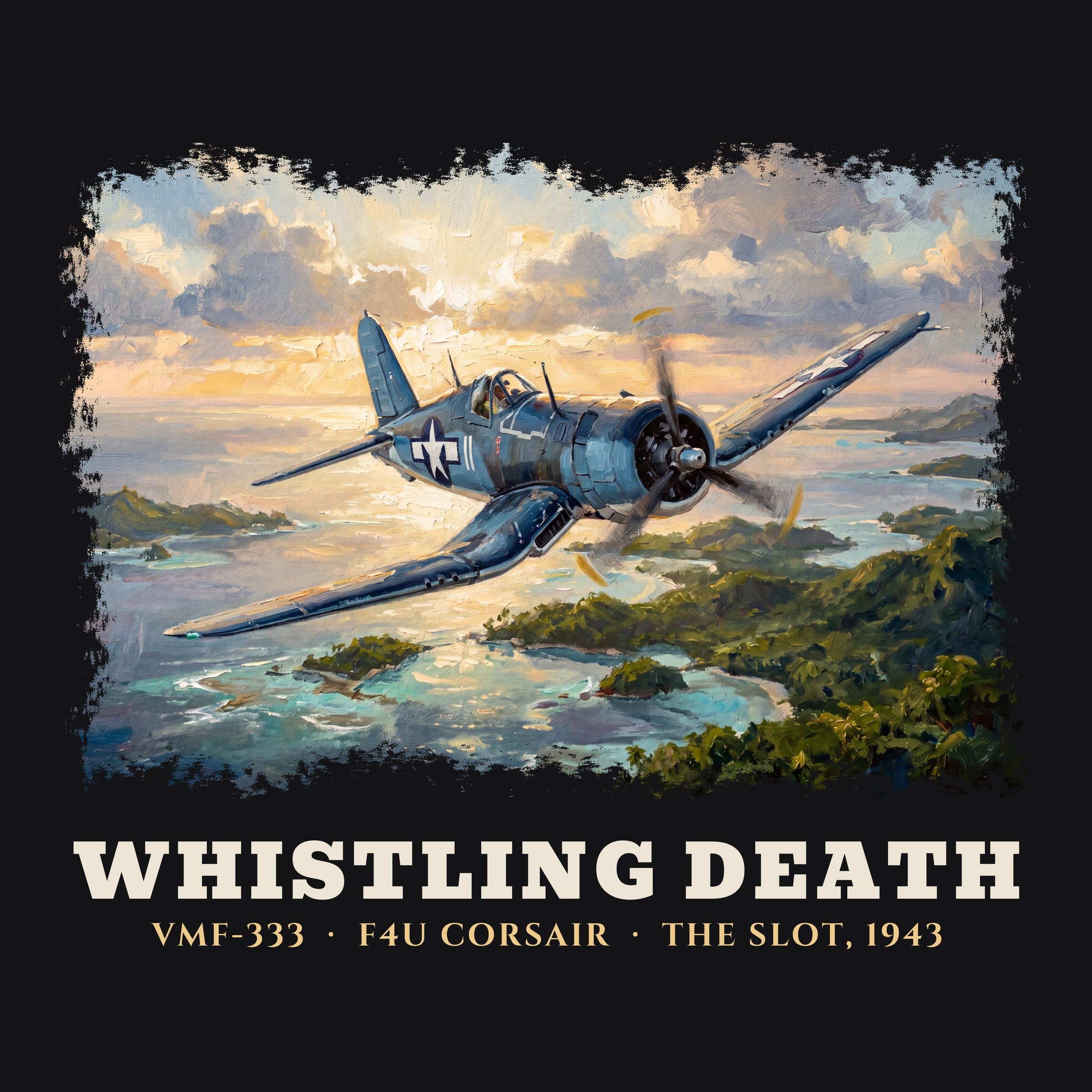
Wear the bent-wing bird
The Whistling Death print puts a Marine F4U Corsair over the Solomons at last light, 1943. On a tee, hoodie or crewneck, printed to order.
Shop the Whistling Death collection →Next Story
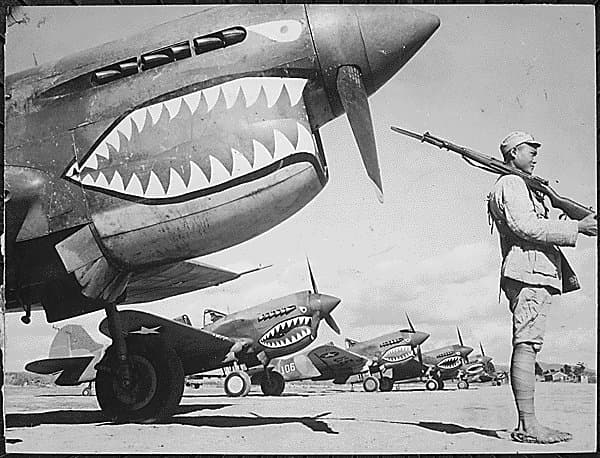
Flying Tigers Shark Mouth
The most iconic nose art in aviation history traveled from a German fighter to a British desert squadron to a newspaper photo to an American diary in China.
Read the story →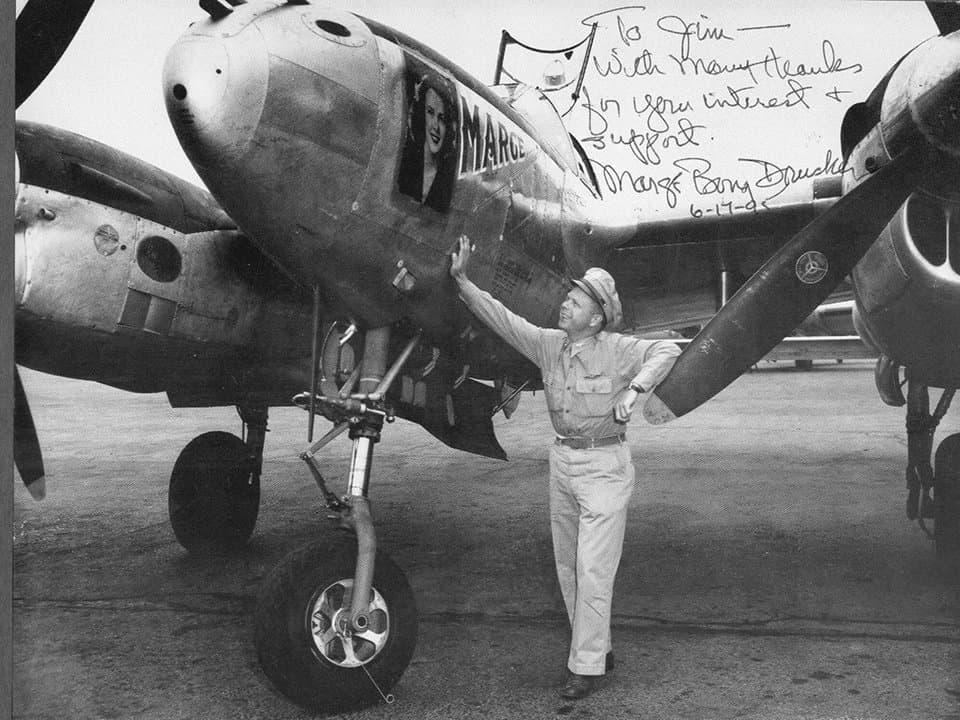
Marge
America's top ace flew with his girlfriend's portrait on the nose. He was killed the day of Hiroshima.
Read the story →