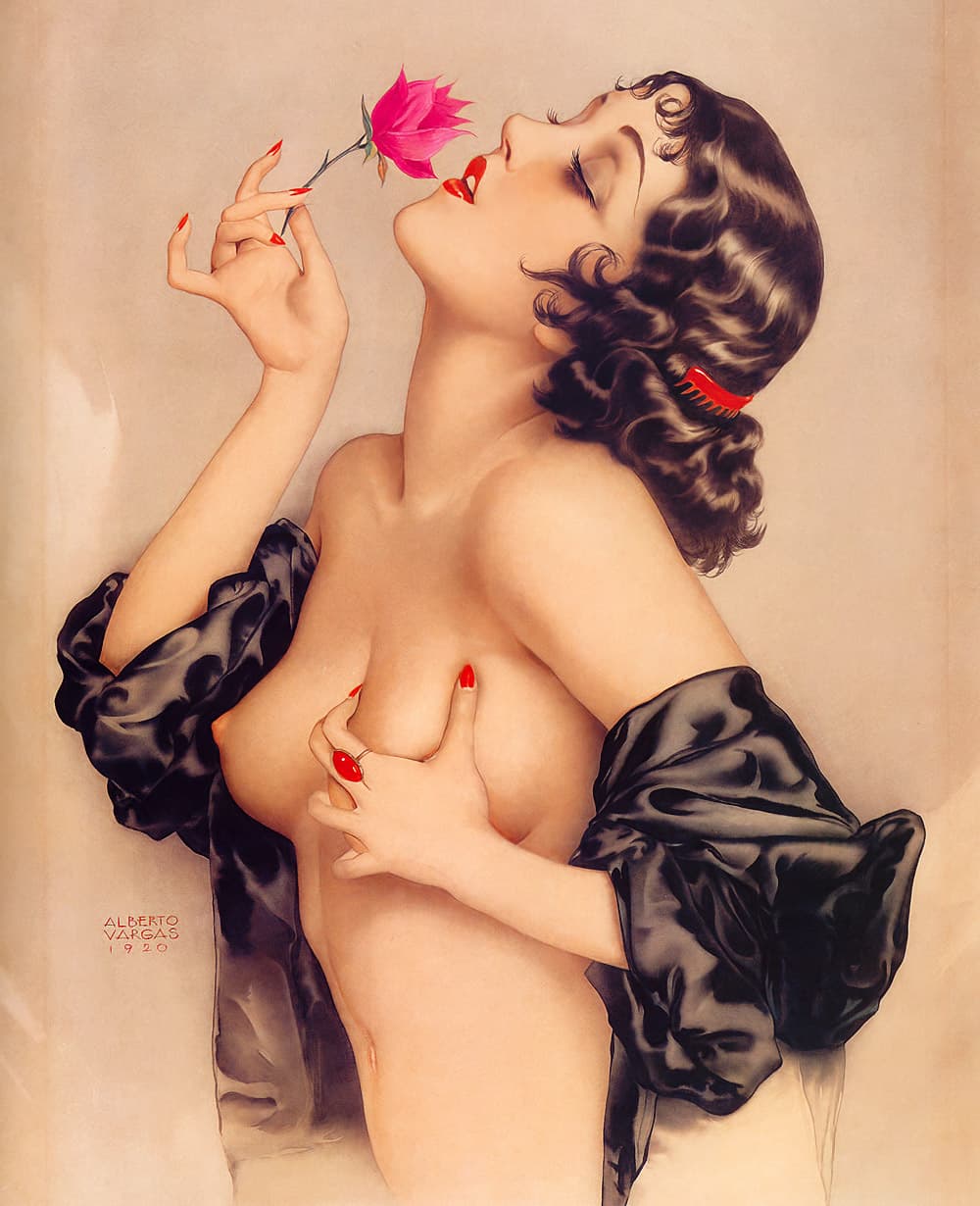
Alberto Vargas
Civilian illustrator (Esquire magazine) · Esquire magazine, New York · 1896-1982
He never painted a single aircraft. Yet the Peruvian illustrator's Esquire pin-ups became the most-copied source in the history of nose art, traveling from a magazine page in a barracks to the aluminum skin of bombers in every theater of the war.
Alberto Vargas never stood on a hardstand. He never drained the oil off a can of house paint or mixed in linseed to make it workable on cold aluminum. He never climbed a stepladder in the English rain to reach the nose of a B-17. He worked in a studio in New York, at a drawing board, with a watercolor brush and an airbrush he had learned to use as a boy in his father's photography shop in Peru. And yet his hand is on more World War II bombers than any painter who actually held a brush on a flight line. The woman on the nose was almost always his.
He was born in Arequipa, Peru, on February 9, 1896, the son of Max T. Vargas, a well-known photographer. He grew up surrounded by cameras, glass plates, retouching dyes, and the airbrush his father used to smooth the skin of portrait subjects. That tool would define his life's work. Before the First World War, the family sent him to Europe, and he studied art in Zurich and Geneva. Somewhere in those years he came across a French magazine, La Vie Parisienne, with a cover by Raphael Kirchner. The idealized, unashamed woman on that cover pointed him toward the thing he would spend six decades drawing.
In 1916 he arrived in New York. He painted showgirls for the Ziegfeld Follies. Through the 1920s and 1930s he made portraits and film posters for Hollywood studios. He built a reputation for a specific kind of image: a woman rendered in soft airbrushed gradients, elongated and poised, sensual without being coarse. He was good, and he was known in commercial circles, but he was not yet famous.
Fame arrived through a contract dispute that had nothing to do with him. In 1940, Esquire magazine's star pin-up illustrator, George Petty, raised his price. Esquire's management went looking for a replacement who could deliver the same glamour for less money. They found Vargas. His first illustrations ran in the October 1940 issue. By December, Esquire had published its first Vargas calendar, twelve women for twelve months, and it sold. Within a year the images had a name and an identity of their own.
They were not called Vargas Girls. Esquire owned that. In the deal, the magazine trademarked the name "Varga," dropping the final s and the apostrophe, and the artist signed his most famous work with a name that was not quite his. The "Varga Girl" belonged to Esquire. The man who painted her was a contractor. That distinction would cost him almost everything after the war, but in 1941 it looked like the best arrangement of his life.
Then the country went to war, and the Varga Girl went with it. After Pearl Harbor, Vargas began dressing his women in the uniforms of the armed services, or in swimsuits striped like signal flags, or draped in patriotic poses. Between 1942 and 1946, Esquire printed more than nine million copies of the magazine, stripped of advertising, and shipped them free to troops overseas to boost morale. The calendars went with them. A serviceman on a base in England or a strip in the Pacific did not have to buy the Varga Girl. She was handed to him.
She went up on the walls first. In barracks, in lockers, in the cabs of trucks, tacked beside photographs of actual wives and mothers and girls back home. The men formed a real attachment to the surreal woman on the page. Some of them came to identify her with the specific women in their lives, and when they finally put her on an aircraft, they gave her a real name, their sweetheart's name, painted below the pin-up in careful letters.
Because that was the next step. A magazine pin-up pinned to a wall is decoration. A pin-up on the nose of a bomber is a talisman. The men who flew in an aircraft that had a fifty-fifty chance of bringing them home wanted something on the skin of the machine, something to carry them out and back. The Varga Girl was the obvious candidate. She was already there, already loved, already in every man's footlocker. The transmission chain was that direct: studio to page, page to overseas mailbag, mailbag to barracks wall, barracks wall to bomber nose.
The men who made that last jump were not Vargas. They were ground crew, mechanics, the occasional pre-war commercial artist, the occasional kid with a gift and no training. They worked from a torn-out page or a calendar month propped against a toolbox. Cpl. Tony Starcer of the 91st Bombardment Group, the most prolific of them all, painted the Vargas-inspired pin-up on Shoo Shoo Baby and more than a hundred other B-17s. He mixed his own flesh tones out of house paint, draining off the surplus oil and thinning it back with linseed, chasing the subtle skin gradients that Vargas got with an airbrush and that Starcer got with a chilled brush in a hangar. In collections like the one at the American Airpower Heritage Museum in Midland, Texas, most of the surviving B-17 and B-24 nose panels trace back to a Vargas original.
The men copying him were inventive in ways he never had to be. Army Air Forces regulations technically banned the more suggestive art, and base inspections could force a cover-up. So crews painted swimsuits onto their nude figures in water-soluble paint, knowing the next rainstorm would wash the modesty away and return the woman to her original state. Others used the aircraft itself. Rivets in the fuselage became the woman's nipples. On the B-24 Double Trouble, the woman's body became the bomber, propellers springing from her breasts. Vargas painted flat idealized figures on paper. On the flight line, his figures were bent around a curved aluminum canvas and wired into the machine.
While his women were multiplying across bombers in every theater, Vargas himself was at the center of a fight in Washington that would help define the limits of American censorship. In 1943, the Post Office moved against Esquire. The charge was that the magazine, the Varga Girls prominent among the evidence, carried matter of an obscene, lewd, and lascivious character, and the Postmaster General ordered Esquire to show cause why its second-class mailing permit should not be revoked. Losing that permit would have crippled the magazine financially. A hearing was held. National figures were summoned to testify on whether a Varga Girl was obscene, among them the critic H. L. Mencken.
The Postmaster General never actually ruled the magazine obscene. He revoked the permit anyway, on the theory that second-class rates were a privilege reserved for publications that contributed to the public good, and that Esquire did not qualify. Esquire sued. The case reached the Supreme Court as Hannegan v. Esquire, Inc., argued on January 11, 1946, and decided on February 4. The decision was unanimous. Justice William O. Douglas wrote that the Postmaster General had no statutory authority to sit in judgment on the merit of what a magazine printed. To allow it, Douglas wrote, would grant the Postmaster General a power of censorship "so abhorrent to our traditions that a purpose to grant it should not be easily inferred." The Varga Girl had helped win a First Amendment case. It was decided the same month the artist's own fortunes began to collapse.
The trademark he had signed away in 1940 came due. When Vargas tried to leave Esquire and take his name and his work with him, the magazine held the rights to "Varga," and the courts sided with the magazine. He could not use the name that had made him famous. The work he had produced belonged to the company that had commissioned it. For most of the 1950s the most-copied illustrator of the war was nearly unemployable under his own brand, painting occasional commercial jobs, watching his signature style get imitated by artists who could sign their own work.
The revival came from an unlikely quarter. In 1959, Playboy began publishing his pin-ups, and Hugh Hefner's magazine gave him what Esquire no longer would. His name went back on his women. Over the next sixteen years he produced more than 150 paintings for Playboy, and the Vargas Girl, spelling and apostrophe restored, became a monthly fixture for a second generation of readers. He worked into the 1970s. His wife and lifelong partner, Anna Mae, managed his affairs until her death, after which his output declined. Alberto Vargas died in Los Angeles on December 30, 1982, at 86.
He is not in this history because of what he painted on an aircraft. He never touched one. He is here because the men who did reached for his work more than any other. Every glamorized woman on a bomber nose, every pin-up bent around a fuselage and renamed for a girl in Ohio, every talisman that carried a crew out over occupied Europe and back, traces up the chain to a drawing board in New York and a Peruvian illustrator with an airbrush he learned to hold in his father's shop. The nose artists are the men who signed the aluminum. Vargas is the man they were copying.
Frequently Asked Questions
- Who was Alberto Vargas?
- Alberto Vargas (1896-1982) was a Peruvian-American illustrator whose Esquire magazine 'Varga Girl' pin-ups became the single most-copied source for WWII aircraft nose art.
- Did Alberto Vargas paint nose art on airplanes?
- No. Vargas never painted an aircraft. Ground-crew artists such as Cpl. Tony Starcer copied his magazine illustrations onto bomber noses, often renaming the figure for a crewman's sweetheart.
- What is a Varga Girl?
- The pin-up illustrations Vargas painted for Esquire magazine from 1940 to 1946. Esquire trademarked the name 'Varga,' dropping the final 's,' so his most famous work was signed with a name that was not quite his own.
- What was Hannegan v. Esquire?
- A 1946 U.S. Supreme Court case, decided unanimously, that stopped the Postmaster General from revoking Esquire's mailing permit over the Varga Girls. It is a landmark First Amendment ruling on censorship through the mail.
- What did Vargas do after Esquire?
- After losing the rights to the 'Varga' name in a postwar legal fight, Vargas revived his career at Playboy beginning in 1959, producing more than 150 'Vargas Girls' with his own name restored.
More Artists
Tony Starcer
The most prolific nose art painter of World War II gave up art after the war, worked in a warehouse for 36 years, and was called out of retirement to repaint his own masterpiece.
Read the story →Sarkis Bartigian
A RISD-trained commercial muralist who enlisted at 36 and created the largest nose art in WWII. Killed in a car accident at 49.
Read the story →