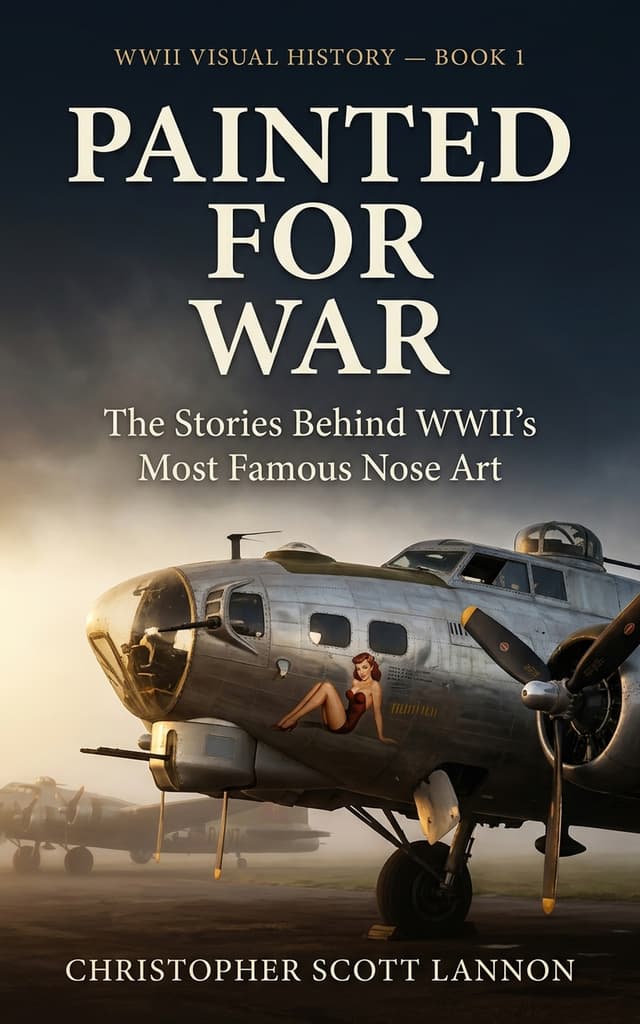
The Complete History of WWII Nose Art
From ancient war paint to the 1993 gender-neutral mandate: why young men facing death personalized their machines, and what happened to the art they left behind.
Before the Bombers: The Ancient Roots of War Paint
The impulse to decorate instruments of war is as old as war itself. Roman legionaries painted shields. Viking longships carried carved prows. Medieval knights bore heraldic devices. The motivation was always the same: to transform an anonymous weapon into something personal, to mark territory, to intimidate the enemy, and to signal belonging to a tribe.
In World War I, the practice moved from shields and ships to aircraft. German and Allied pilots painted personal insignia on their biplanes. The most famous was Manfred von Richthofen’s all-red Fokker Dr.I, but hundreds of other pilots marked their aircraft with symbols, initials, and kill tallies. The practice was informal, personal, and small-scale.
World War II industrialized it. The United States Army Air Forces produced over 300,000 aircraft during the war. Tens of thousands of these carried some form of nose art. What had been a pilot’s personal tradition became a mass cultural phenomenon, driven by three forces: the morale needs of young men facing statistically improbable survival, the pin-up magazine culture they carried from home, and the availability of artists among the enlisted ground crew.
The Pin-Up Connection: Vargas, Petty, and Elvgren
The dominant source material for WWII nose art was the pin-up magazine.Alberto Vargas and George Petty at Esquire, Gil Elvgren at Brown and Bigelow, and dozens of lesser-known illustrators produced the images that American servicemen carried overseas in their duffel bags and taped inside their lockers. The economic chain that connected the New York studios to the bomber noses — the calendar contracts, the nine million free magazines, the women artists who never got barracks credit — is covered in detail on the pin-up influence pillar.
The transmission chain was direct: a magazine illustration would arrive at an airbase in a mail delivery. A crew would tear out the page and hand it to the unit’s artist. The artist, often a mechanic with no formal training, would copy or adapt the image onto the aluminum fuselage of a bomber or fighter using whatever paint the ground crew could scrounge. The image moved from a New York art studio to a B-17 fuselage in England to a smelter in Arizona, all within the span of three years.
Forty-three percent of nose art in the European Theater depicted women. In the Pacific Theater, that figure rose to sixty-six percent. The Pacific was more permissive, partly because crews were more isolated from civilian populations and inspectors. America’s top ace, Richard Bong, flew P-38 Lightnings carrying a colorized photograph of his girlfriend — the nose art known as Marge — while the most iconic design of the war, the Flying Tigers shark mouth, traveled from a German fighter to a British squadron in North Africa to the AVG in China.
The Artists Nobody Remembers
The Army Air Forces had no Military Occupational Specialty for “artist.” The men who created the most recognizable visual culture of the war were classified as mechanics, draftsmen, and crew chiefs. They painted between shifts, during off-hours, at the request of crews who wanted their aircraft to carry something personal into combat.
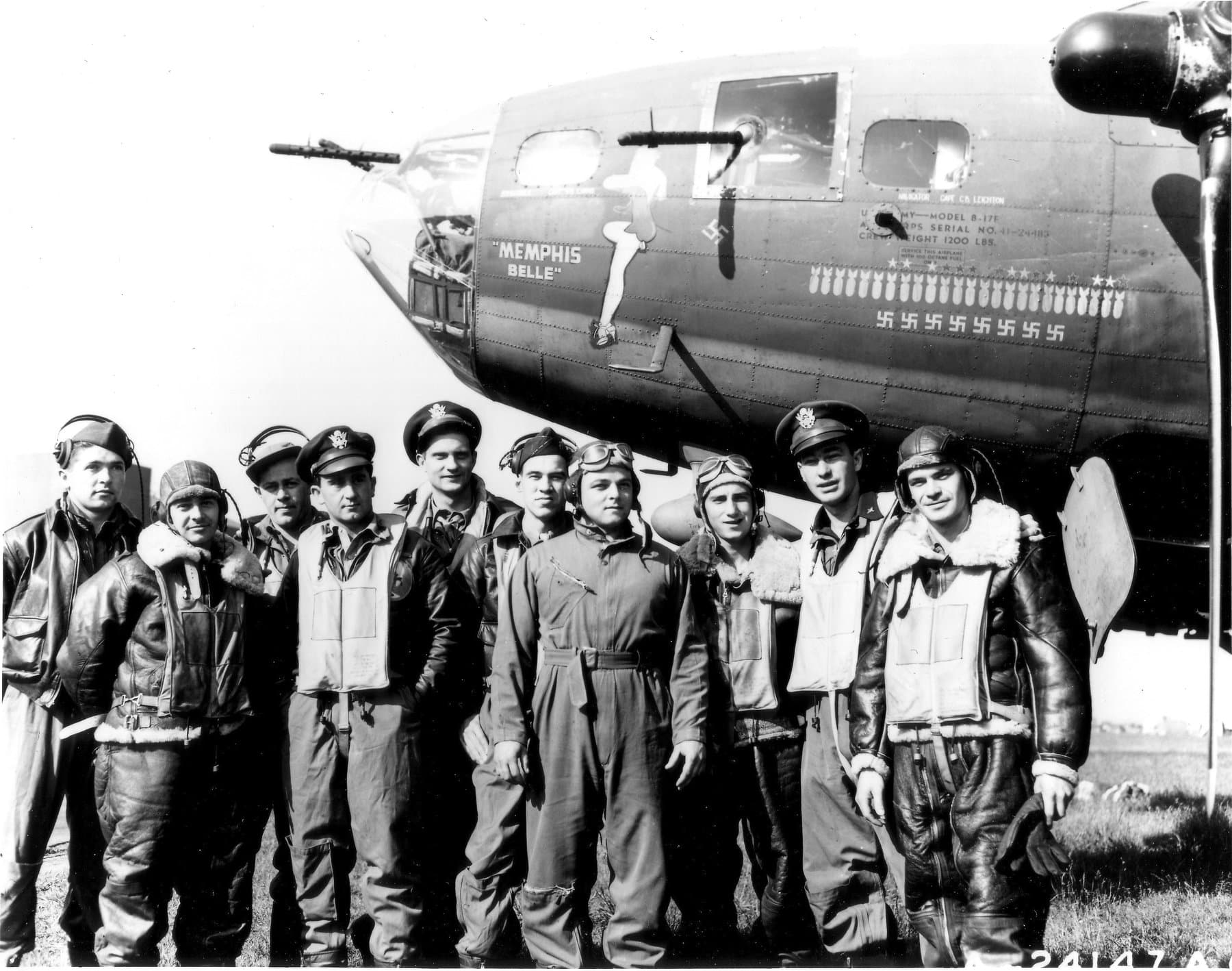
A handful left enough records to reconstruct their biographies. Tony Starcer painted approximately 130 B-17s for the 91st Bomb Group, including the Memphis Belle and Shoo Shoo Baby. Sarkis Bartigian created The Dragon and His Tail, the largest nose art in the war. Cleveland School of Art graduate Don Allen painted over sixty fighters for the 4th Fighter Group, and advertising art director Phil Brinkman created the Zodiac Nose Art series for the 834th Bomb Squadron. Most others remain anonymous. Their work survives only in photographs.
The Psychology of Nose Art
In the Eighth Air Force, bomber crews flying from England over Germany faced a statistical probability of death that few other military assignments matched. The completion of twenty-five missions was considered so unlikely that it made national news when the Memphis Belle accomplished it. In this context, nose art served a function beyond decoration.
The painted woman on the fuselage was a talisman. Crews spoke of their aircraft as if the art made them lucky. The Vargas girls became “a protective talisman for their crews, which reminded them of their home and why they fought,” painted as “a symbol of good luck or as a kind of goddess of war.” In an environment where rational calculation predicted death, irrational attachment to a painted image provided psychological armor.
The Destruction
When the war ended, the art was destroyed at an industrial scale. At Kingman, Arizona, the Wunderlich Contracting Company received a $2.78 million contract to reduce 5,400 aircraft to aluminum ingots: 4,463 heavy bombers, 615 fighters, 266 medium bombers. By July 1948, less than three years after the war ended, the job was done.
Virtually all original nose art was lost. Only a handful of complete aircraft survived. Only thirty-four original nose art panels exist today, saved by a junkyard manager named Minot Pratt at Walnut Ridge, Arkansas, who directed his workers to cut the panels with axes before the fuselages were fed into the smelter. Those thirty-four panels are now Smithsonian-certified national treasures at the NAEC in Dallas.
The End of a Tradition
Nose art continued through the Korean War and Vietnam, but with increasing restrictions and declining volume. Jet aircraft provided less surface area. Military culture became more bureaucratic. The informal wartime tolerance for personal expression gave way to formal approval processes. Even the most consequential bomber of the war, the Enola Gay, carried only a name in plain black letters — a quiet ending for a visual tradition that had defined the previous decade. Its sister ship Bockscar, which bombed Nagasaki, received its winged-boxcar art only after the mission was flown.
In 1993, the USAF Air Mobility Command declared all nose art must be gender-neutral. A 2015 memorandum codified requirements that nose art be “distinctive, symbolic, gender neutral, intended to enhance unit pride, designed in good taste.” The tradition that defined WWII visual culture was formally ended by regulation.
What survives today lives in museums, in photographs, in the memories of families, and in the thirty-four panels that Minot Pratt saved from the smelter. Record-setting bombers like the Nine-O-Nine were melted at Kingman, while a rare few like the desert-pink Strawberry Bitch survived, and Canadian historian Clarence Simonsen spent fifty years recreating the vanished art on salvaged aluminum. The stories behind the art have never been told as narrative nonfiction. Until now.
Frequently Asked Questions
- Why did WWII planes have nose art?
- WWII nose art served multiple psychological functions: it personalized anonymous war machines, boosted crew morale, served as talismans against death (crews with 35% survival rates needed any source of psychological comfort), expressed unit identity, and connected crews to home through images of sweethearts and pin-up girls from popular magazines.
- Was nose art allowed in WWII?
- Nose art was never officially sanctioned but was widely tolerated by commanders for its morale benefits. A January 31, 1944 Eighth Air Force directive stated commanders were responsible for censoring or approving unofficial names. Full nudity was frowned upon, and some crews used water-soluble paints anticipating inspection.
- When did the military ban nose art?
- In 1993, USAF Air Mobility Command declared all nose art must be gender-neutral. A 2015 memorandum codified requirements that nose art be 'distinctive, symbolic, gender neutral, intended to enhance unit pride, designed in good taste.' Modern nose art exists but bears little resemblance to the WWII era.
- What happened to WWII nose art?
- The vast majority was destroyed. At Kingman, Arizona alone, 5,500 aircraft including 4,463 heavy bombers were scrapped between 1945-48. Only 34 original nose art panels survive, saved by junkyard manager Minot Pratt who directed workers to cut panels with axes before the aircraft were melted. These panels are now Smithsonian-certified at the NAEC in Dallas.