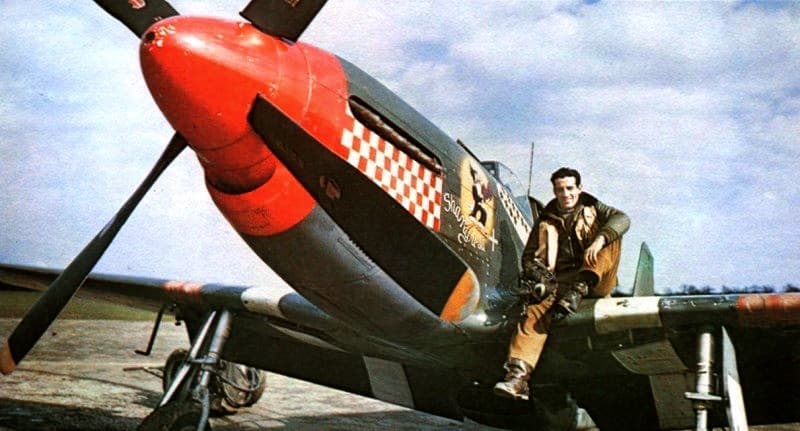
Don Allen
Crew Chief · 4th Fighter Group, 334th Fighter Squadron · c. 1920-?
An art school graduate who served as crew chief and painter, then returned to a 50-year career in advertising art.
Don Allen graduated from the Cleveland School of Art in 1941 with a major in illustration. He had one year of civilian life before the draft caught up with him in December 1942. The Army trained him as an engine and airframe mechanic and sent him to England, where he was assigned to the 4th Fighter Group's 334th Fighter Squadron as a crew chief.
The 4th Fighter Group had a distinguished lineage. It descended from the Eagle Squadrons, volunteer American pilots who had flown with the Royal Air Force before the United States entered the war. By the time Allen arrived, the group was flying Spitfires, then transitioning to P-47 Thunderbolts, and finally to P-51 Mustangs.
Allen served as both crew chief and artist simultaneously. He created over sixty airplane names and mascots for the 4th Fighter Group, adorning Spitfires, Thunderbolts, and Mustangs as the group transitioned through three different fighter types. New pilots transferring into the group often requested his services. He was the unofficial group artist, working between his mechanical duties to personalize the aircraft that his pilots flew into combat.
After the war, Allen returned to Cleveland and picked up where he had left off. He joined Ad Art Studios in Cleveland and worked as an advertising artist until his retirement in 1995. A fifty-year career in commercial art, bookended by four years of painting fighter planes in England.
Allen's story is the counterpoint to Tony Starcer's. Where Starcer abandoned art and disappeared into a warehouse, Allen went home and built the career his training had prepared him for. Both men painted nose art. Both were good at it. One found the war a dead end for his talent. The other found it a detour.
Frequently Asked Questions
- Who was Don Allen?
- A Cleveland School of Art illustration graduate who served as a crew chief and unofficial artist for the 4th Fighter Group's 334th Fighter Squadron in England.
- How many aircraft did Don Allen paint?
- Over sixty names and mascots for the 4th Fighter Group, on Spitfires, P-47 Thunderbolts, and P-51 Mustangs as the group transitioned through three fighter types.
- What did Don Allen do after the war?
- He returned to Cleveland, joined Ad Art Studios, and worked as an advertising artist until retiring in 1995, a 50-year commercial art career.
- How is Don Allen the counterpoint to Tony Starcer?
- Both painted nose art well, but Starcer abandoned art for a warehouse job while Allen went home and built the career his training had prepared him for.
More Artists
Tony Starcer
The most prolific nose art painter of World War II gave up art after the war, worked in a warehouse for 36 years, and was called out of retirement to repaint his own masterpiece.
Read the story →Sarkis Bartigian
A RISD-trained commercial muralist who enlisted at 36 and created the largest nose art in WWII. Killed in a car accident at 49.
Read the story →