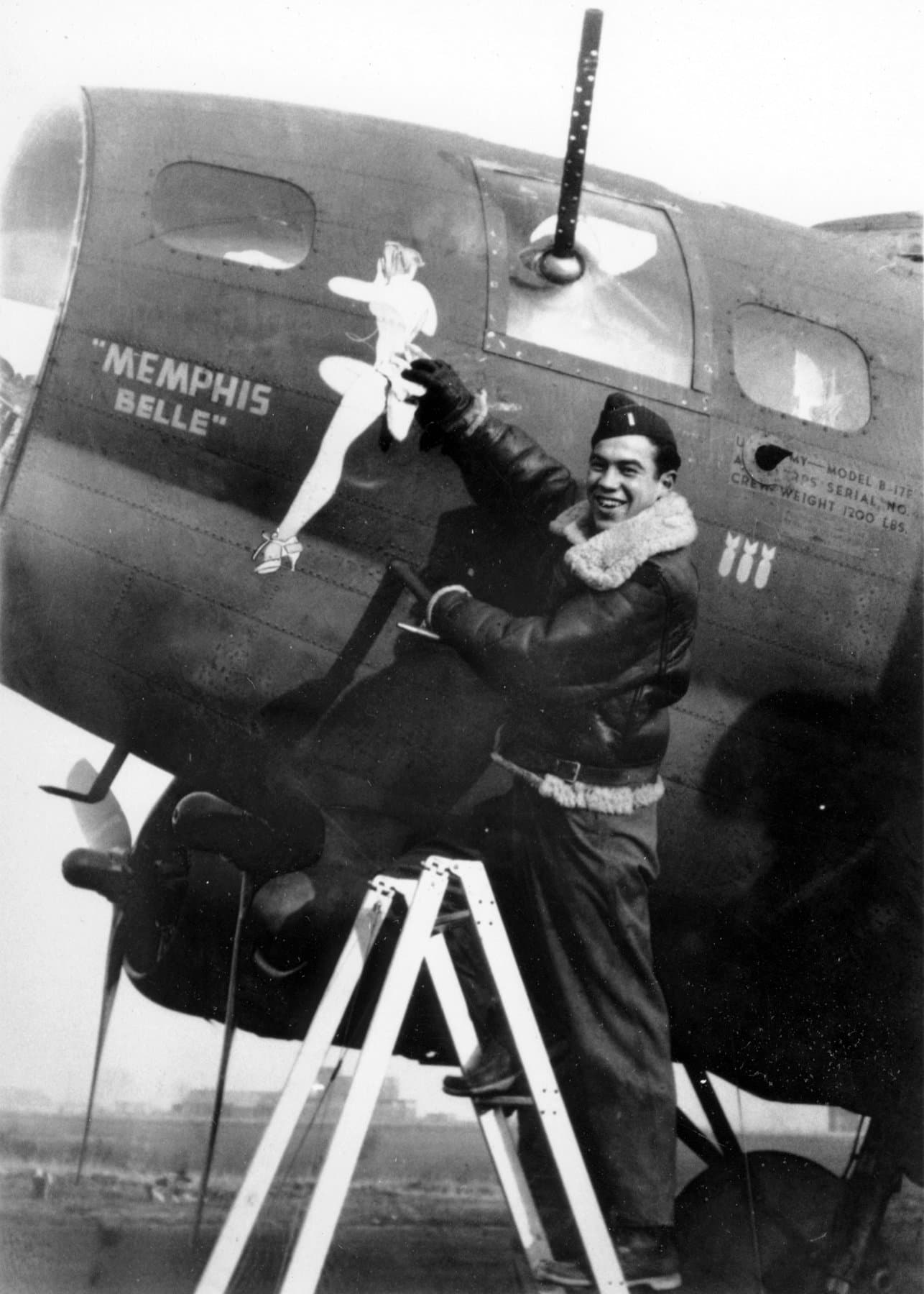
Memphis Belle
B-17F-10-BO · 41-24485
The most famous bomber of World War II carries a pin-up nobody posed for, painted by a mechanic who gave up art after the war.
Captain Robert K. Morgan met Margaret Polk at Walla Walla Army Air Base in southern Washington during advanced flight training in 1942. She was a Memphis debutante, twenty years old. Morgan was a North Carolinian with a complicated history of marriages already behind him and a B-17 ahead of him. He told her he wanted to name his airplane "Little One," his pet name for her. Then he saw the 1942 RKO picture Lady for a Night, in which John Wayne and Joan Blondell argue over a Mississippi riverboat christened the Memphis Belle. Morgan proposed the new name to his crew and they voted to approve it. The name was a tribute to a woman, a piece of borrowed iconography, and an inside joke about a movie, all at once.
Morgan was already a reader of Esquire. Along with most of the men he flew with, he watched for the magazine's monthly gatefolds by Alberto Vargas and George Petty. Sometime in 1941 he had seen a Petty illustration of a long-legged brunette in a swimsuit and had decided, well before he had a bomber to put her on, that she would be his nose art. He wrote to the magazine, asked for permission, and received a copy of the print by return mail. The illustration had appeared in the April 1941 issue. Its official title was not "The Memphis Belle." Petty had called it "I'm the one with the part in the back." The painting was modeled, according to subsequent reporting, by Petty's own daughter Marjorie Petty-Macleod, who was sixteen years old at the time it was drawn. Morgan did not know this when he requested the print. The crew never learned it during the war.
The first attempt at painting the Petty girl onto Morgan's B-17 happened at Dow Field in Bangor, Maine, in the days before the crew departed for England. A base worker did the job. It was, by surviving accounts, a poor likeness. When the bomber arrived at Bassingbourn in the autumn of 1942 and was assigned to the 91st Bomb Group, 324th Bomb Squadron, Morgan found the man who was already becoming a legend on the base. Corporal Anthony L. "Tony" Starcer had been a line mechanic with no particular reputation for art until, on a training base in Texas, he had walked into the Officers' Club, criticized a mural that another man was painting, and been told to finish it himself. He did. By the time he reached Bassingbourn the 91st had quietly handed him the unofficial job of resident artist. The B-17s of "The Ragged Irregulars" — the 91st's nickname — began carrying his work on their noses, and the demand quickly outpaced his ability to keep up.
Starcer worked with what he could scrounge. House paint, mostly. He drained the surplus oil off the cans and thinned the remainder with linseed oil to make it workable on aluminum. He painted in rain and biting wind and English cold, on a flight line that had no studio and no shade. He could finish the nose of a B-17 in a single day. He had assistants who handled the lettering and the leather-jacket patches he gave the crews on the side; that left him free to concentrate on the figures. The flesh tones in his pin-ups surprised everyone who knew the working conditions. By the end of his service the 91st Bomb Group website would list 124 aircraft his work had touched, with other accounts putting the number closer to 130.
On the Memphis Belle, Starcer repainted the Petty girl on both sides of the forward fuselage and made a small but specific editorial choice. On the port side, he gave her a blue swimsuit. On the starboard side, he gave her a red one. The two sides of the most famous bomber of the war are, in a strict sense, not the same painting. The detail is invisible to anyone looking at a single archive photograph and easy to miss in a museum walkaround that favors one approach. It is the kind of thing only the artist who painted both panels would think to do and only the men who maintained the aircraft would notice.
The Memphis Belle became famous in May 1943 as one of the first B-17s in the Eighth Air Force to complete the then-mandatory twenty-five combat missions. The crew's twenty-fifth mission, on May 17, 1943, was a raid on the Keroman submarine base at Lorient on the French Atlantic coast. The mission itself was uneventful by Eighth Air Force standards — what the men called a milk run — with no casualties on the Belle and no difficult landing. None of that mattered. The aircraft and its crew were exactly the propaganda asset the War Department had been waiting for. Within weeks they were on a plane back to the United States for a public-relations tour. The official photographs of the crew were taken on the flight line at Bassingbourn before they left: Pilot Robert Morgan, co-pilot Jim Verinis, navigator Chuck Leighton, bombardier Vince Evans, top turret Harold Loch, ball turret Cecil Scott, radio Robert Hanson, tail gun John Quinlan, right waist Tony Nastal, left waist Bill Winchell, ten men in heavy jackets standing under the Petty girl in the blue swimsuit.
Director William Wyler, an Academy Award winner serving as a major in the Army Air Forces, had been on the ground at Bassingbourn during the spring of 1943 with a small crew of cinematographers. He intended to make a War Department documentary about the Eighth's bomber war, and he had chosen the Memphis Belle as the narrative anchor. The film he produced, released in April 1944 as The Memphis Belle: A Story of a Flying Fortress, was shot on 16-millimeter Kodachrome film and blown up to 35 millimeter for theatrical release. American audiences in 1944, accustomed to black-and-white newsreels, were not prepared for what color did to combat footage: blue sky, orange flak, red blood. The film was an immediate sensation.
What the audience did not see is what makes the documentary, eighty years later, still worth study. The combat footage was real — Wyler's cinematographers flew on actual bombing raids in B-17s and B-24s deep into German-controlled airspace, and one of them, Lieutenant Harold J. Tannenbaum, was killed in action when the bomber he was filming from was shot down on a mission against the U-boat bases at Brest and Lorient. The footage Wyler edited into the film, however, was not exclusively from the Memphis Belle and was not exclusively from its twenty-fifth mission. Bombing runs that the film attributes to the Belle's final mission over Lorient have been geo-located by later researchers to Saint-Nazaire, Rennes, and Wilhelmshaven. The narrative arc of one bomber over one target was a composite. The intercom dialogue heard in the film was not real either. The roar of four engines on a B-17 in combat made live audio recording impossible. After the crew returned to the United States on the war-bond tour, they sat in a Hollywood sound studio, watched the silent footage, and recorded the lines Wyler wanted them to say. The result, in the words of one later analyst, was difficult to distinguish from a genuine in-flight recording. None of this is to accuse the film of dishonesty. It is to observe that what an audience in 1944 was told it was watching — the actual last mission of one specific aircraft and one specific crew — was, in the cleanest sense, a Hollywood reconstruction with real flak and real dead in the editing-room dailies.
What the publicity tour also did not say was that Margaret Polk and Robert Morgan had already, by the time the bond drive began, ceased to be the engaged couple the press releases described. Polk had telephoned Morgan in Denver during the early American leg of the tour. A woman answered the phone. Polk gave an interview about that moment in 1989, a year before she died, and the way she described it in old age preserved the specific dryness of having to explain something that had been packaged into legend. The engagement had to be broken in writing, with the consent of the War Department, because the press story was now official property. Polk and Morgan agreed to finish the bond tour as a couple anyway. They appeared on stages. They sold bonds. They saw the tour through to the end. Margaret Polk never married. She died of cancer in Memphis on April 5, 1990, at sixty-seven. Robert Morgan married five other women across his life and was on his sixth marriage when he died in 2004. He and Polk had remained friends. The last time he saw her, he said, was at a Memphis Belle ceremony on Mud Island three years before her death.
The aircraft survived all of this and then nearly did not survive the peace. After the war-bond tour the Memphis Belle was flown to Altus Army Air Field in Oklahoma. Between 1945 and 1953 Altus served as a boneyard for several thousand surplus warbirds, most of which were broken up and smelted. In 1945 a representative of the City of Memphis found the Belle on the Altus flight line, awaiting disposal, and persuaded the Air Force to release it. The aircraft was flown to Memphis and placed on outdoor display at the National Guard Armory in 1949. It sat there, in the open, for nearly four decades. Its paint faded, its skin oxidized, and its interior was steadily stripped — sometimes by souvenir hunters, sometimes by maintenance crews scavenging for parts. On May 17, 1987 — forty-four years to the day after the twenty-fifth mission — the aircraft was relocated to Mud Island in the Mississippi River and placed under a white vinyl canopy on a steel-beam pavilion. The new shelter kept the rain off. It did not keep off the humidity of Memphis summers, the wet cold of Memphis winters, or the pigeons that nested in the cowlings.
By the early 2000s the city could no longer credibly preserve the aircraft. In October 2005 the Air Force reclaimed it. The Belle was disassembled, trucked to Wright-Patterson Air Force Base outside Dayton, and turned over to the restoration shop of the National Museum of the United States Air Force. What followed was a thirteen-year project. Restorers stripped the post-war paint and inscriptions back to bare aluminum. They found, scratched into the skin of the aft fuselage, thousands of names and short messages — many of them dating back to the 1943 war-bond tour, when crowds at airfield stops had been allowed to inscribe their initials directly on the airplane. Restorers documented each inscription, photographing examples like "V. Papa, Lynn, MA 12-31-44" before deciding which to preserve and which to overpaint to bring the exterior back to its May 1943 configuration. The original aluminum airframe, the original ribs, and the original structural members were preserved where they could be, cleaned, treated for corrosion, and reused. The fabric-covered control surfaces, which rot, were rebuilt from scratch. Missing interior equipment, wiring, turrets, and guns were replaced with period-correct parts salvaged from other B-17s. The exterior paint was matched to combat-era reference photographs to reproduce the configuration of the aircraft as it had stood at Bassingbourn in May 1943. The project consumed roughly 55,000 hours of staff labor across more than a dozen years.
On March 14, 2018, the restored Memphis Belle was rolled into the museum's World War II Gallery in Dayton. On May 17, 2018 — seventy-five years to the day after the twenty-fifth mission — it was officially unveiled to the public. The aircraft on display is, by the measure of any honest conservator, a hybrid: original where the original could be saved, faithfully reconstructed where it could not. The Petty girl on the nose is a recreation, not Starcer's hand. Starcer himself died in California in June 1986, before the restoration project began. He had given a brief, direct explanation of the long civilian silence between the war and the 1981 Shoo Shoo Baby commission: "When I came out of the service the competition in art was real strong and I wanted to get married, so I just got a job and gave up art." The job was at the May Company distribution center in Norwalk, California. Starcer rose to division manager and worked there for twenty-nine years, retiring in February 1985, roughly a year before he died. The man who had put pin-ups on more than 120 B-17s for the most photographed bomb group in the Eighth Air Force had spent the years between Bassingbourn and Dover Air Force Base managing a department-store warehouse in a Los Angeles suburb. He completed thirteen original oil-on-canvas reproductions of his most famous wartime designs just before his death, and the National Museum of the Mighty Eighth Air Force acquired that collection in 2025.
The afterlife of the Memphis Belle is a record of three accidental decisions. The first was Morgan's choice, in 1942, of an Esquire gatefold whose model and title he did not know. The second was the City of Memphis recovering the airplane from the Altus boneyard in 1945 — a saving act that nearly ended the aircraft's life anyway through forty years of weather. The third was the National Museum's choice, in 2005, to undertake the restoration as a permanent rebuild rather than a stabilization. The museum took the position that what was being preserved was not the specific aluminum of the wartime airframe — much of which had been scavenged or had corroded — but the visual identity of the aircraft as it had appeared at Bassingbourn on May 17, 1943. The result is honest within its premises and disorienting outside them. The names scratched into the fuselage by bond-tour crowds in the winter of 1943–44 are now mostly under paint. The Petty girl on the nose has been painted by three different hands in eight decades. The aircraft is the Memphis Belle, and the Memphis Belle is partly a costume.
The Wyler documentary has, in the long run, exerted more influence on the bomber's public memory than the bond tour or the museum itself. The film was rediscovered by documentary maker Erik Nelson in the mid-2010s when he learned the raw footage Wyler had used to cut the 1944 picture was still held at the National Archives — thirty-four reels, roughly ninety hours of unseen Kodachrome. Nelson restored that material at 4K resolution and used it to assemble a new feature documentary, The Cold Blue, released in 2018. The 2018 film, screened in the same year the restored Belle was unveiled at Dayton, accidentally completed the round trip. The aircraft, the Petty girl on its nose, the men who flew her, and the footage Wyler shot of them all returned to the public eye inside the same calendar season — the airplane in its bond-tour configuration, the men preserved in the color of the year they survived. The dramatic 1990 feature film Memphis Belle, directed by Michael Caton-Jones with Matthew Modine, drew its title and premise from Wyler's documentary and its commercial appeal from the Polk-Morgan romance the bond tour had advertised. That movie sits, more than the airframe at Dayton, in the head of any American who knows the name.
The aircraft sitting in Dayton today is recognizably the Memphis Belle that came home from Lorient in May 1943. The Petty girl on the port side wears the blue swimsuit. On the starboard side she wears the red. Marjorie Petty-Macleod, who modeled for her father's drawing as a teenager, has no public association with the bomber's legend. Margaret Polk, whose name the airplane was meant to honor, lies in Memphis Memorial Park. Tony Starcer, the mechanic who painted the pin-up on the side of every B-17 the 91st could throw at him, signed almost none of his work and was paid for none of it. The most photographed nose art of the Second World War was a teenage girl posing for her father's commercial illustration, transferred to aluminum by a man who would not pick up a paintbrush again for decades, on behalf of a pilot whose engagement was already failing when the publicity tour landed. The legend is more durable than any of the people inside it. That is what a successful piece of nose art is supposed to be.
Frequently Asked Questions
- Who painted the Memphis Belle nose art?
- Corporal Tony Starcer of the 91st Bomb Group painted it, copying a George Petty pin-up from the April 1941 Esquire. He gave the figure a blue swimsuit on the port side and a red one on the starboard.
- Was the Memphis Belle the first B-17 to complete 25 missions?
- It became famous in May 1943 as one of the first B-17s in the Eighth Air Force to complete 25 combat missions, which triggered a War Department publicity tour and a William Wyler documentary.
- Who was the Memphis Belle named after?
- Pilot Robert Morgan named it after Margaret Polk, a Memphis woman he was courting, borrowing the name from the 1942 film Lady for a Night.
- Where is the Memphis Belle now?
- On display at the National Museum of the United States Air Force in Dayton, Ohio, after a 13-year restoration of roughly 55,000 staff hours.
Next Story
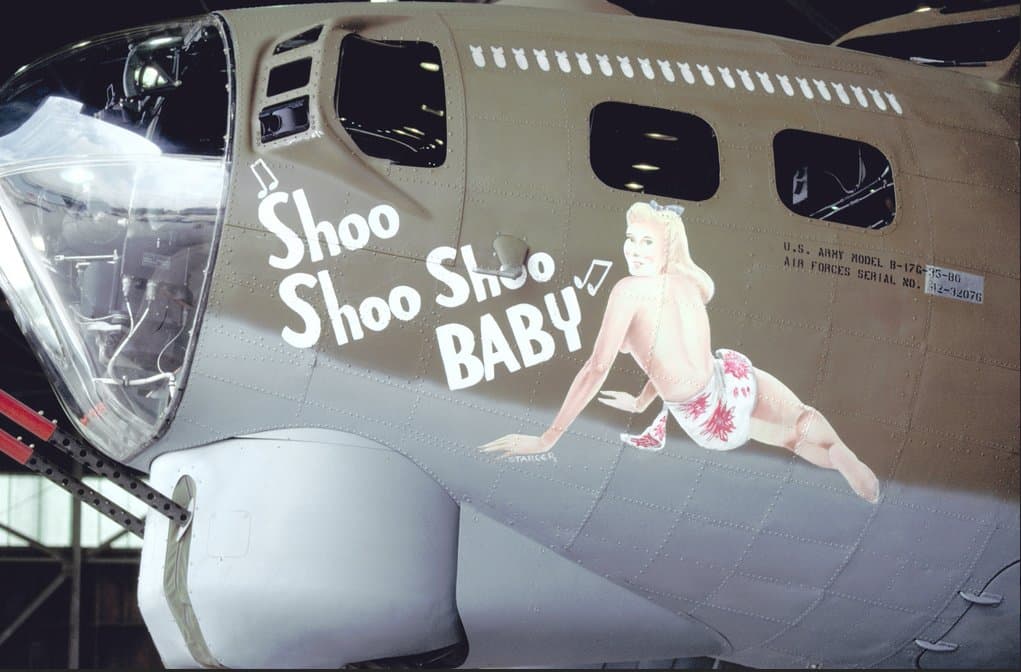
Shoo Shoo Baby
A bomber that traveled from England to Sweden to France to Germany to America. Its artist returned after 36 years to repaint it.
Read the story →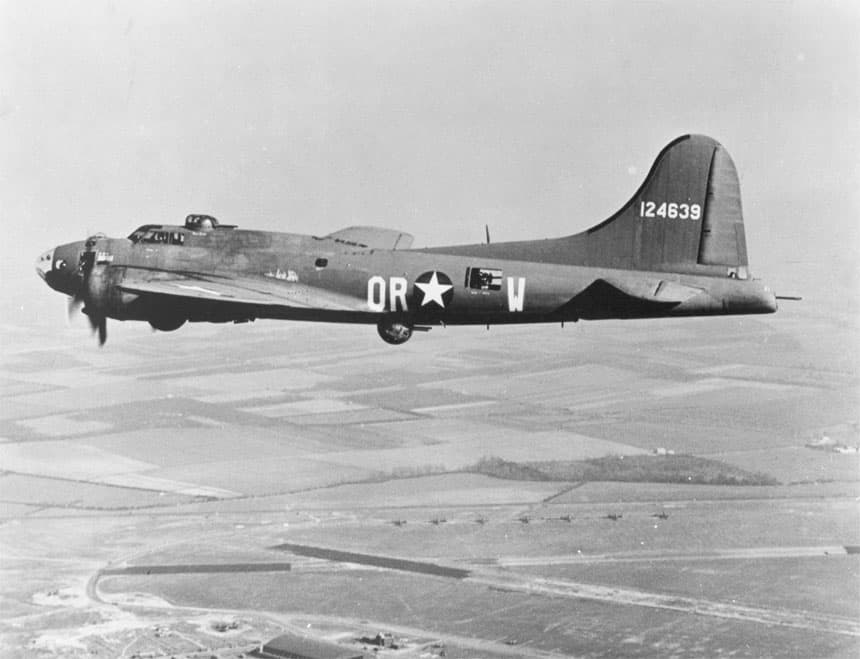
Nine-O-Nine
A B-17 that flew 140 combat missions and brought every crew home, named for nothing more than the last three digits of its serial number.
Read the story →