The Pin-Up Influence on WWII Nose Art
How an Esquire gatefold, a Brown and Bigelow calendar, and a tattoo shop in Honolulu put four illustrators on the noses of American bombers — and what the post-war mandate cut away.
The Model Who Never Knew the Airplane Existed
In the spring of 1941, the illustrator George Petty asked his daughter to pose for a gatefold for the April issue of Esquire magazine. The painting was titled “I’m the one with the part in the back.” The model was Marjorie Petty-Macleod — according to Reid Stewart Austin’s definitive monograph on Petty’s work, produced in cooperation with Marjorie herself, she was twenty-one years old. For decades the figure circulated in books and on plaques as sixteen. The corrected age is in the literature now. The face and the legs are not corrected. They are the same face and legs that appeared on the most famous bomber of the Second World War.
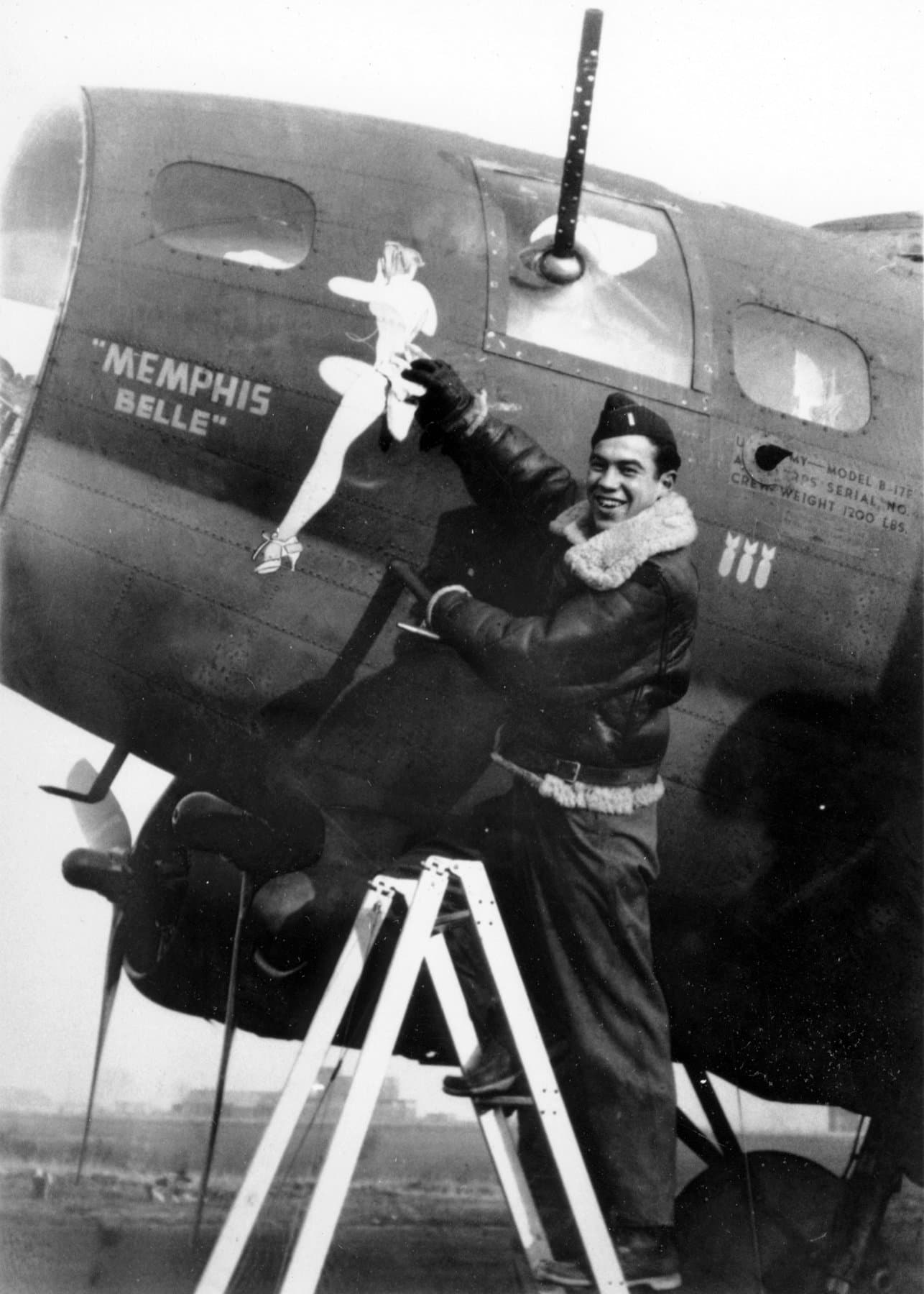
Captain Robert K. Morgan saw the gatefold somewhere in 1941, on a training base or in a barracks. He wrote to the magazine and asked for permission to use the image on the B-17 he had not yet been assigned. Esquire mailed him a print. A base worker at Dow Field in Bangor, Maine, applied it to the bomber that became the Memphis Belle. A mechanic at Bassingbourn, England, repainted it. The aircraft completed twenty-five combat missions, became the propaganda anchor of a War Department documentary, and went home in the spring of 1943. Marjorie Petty-Macleod had no public association with any of this until decades later. She modeled for an illustration. The illustration went to war without her.
That gap — between the woman who posed and the men who flew, between the New York studio and the English flight line, between the price George Petty charged Esquire and the psychological cost Esquire was paid to deliver — is the whole subject of this page. The pin-up artists who shaped the visual culture of WWII nose art were not on the bases. They were in commercial studios in Chicago and St. Paul and New York and Honolulu. The mechanics who put their work on aluminum had in many cases never met them. The chain that connected the two ran through magazine paper, calendar pages, and the U.S. Army Postal Service.
The Calendar Economy
American pin-up illustration in 1940 was not pornography. It was a commercial-art segment with three dominant outlets: Esquire magazine, the Brown and Bigelow Calendar Company of St. Paul, and the Louis F. Dow Calendar Company across town. The economic logic was identical at each: a publisher paid an illustrator a flat fee or a salary, retained the reproduction rights, and sold the images downstream as calendar prints, ink blotters, matchbook covers, mutoscope cards, and twelve-page booklets. The pin-up was a content product whose unit economics worked the same way as a soft-drink advertisement.
The volume those publishers moved is the part that surprises a modern reader. Between 1942 and 1946, Esquire sent more than nine million advertisement-free copies of the magazine overseas free of charge to American servicemen. Brown and Bigelow produced calendars for tens of thousands of corporate clients, each one buying its name printed on the cover and a different Vargas or Elvgren girl printed on each month. The Louis F. Dow Company repackaged Gil Elvgren’s pre-1944 pin-ups into small booklets specifically designed to be mailed overseas to soldiers without an envelope. The wartime calendar economy was an industrial-scale distribution system for a single visual vocabulary — a long-legged American woman in a swimsuit, a dressing gown, or a service-branch uniform — that followed the U.S. military to every theater of the war.
The mechanic on a Pacific base did not have to know who painted the source image. He had to know how to copy it. The April 1941 Petty gatefold reached Tinian and Bassingbourn and Foggia in the same shipping crates as cigarettes and razor blades. The image was free. The aluminum was free. The hour between repairs was free. What was missing was the artist — and almost every bomb group had one.
George Petty
George Petty was the first pin-up artist Esquire put on its gatefolds and the reason the magazine had a centerfold economy at all. His “Petty Girls” were tall, airbrushed, sleek — less realistic than Elvgren, more stylized than a photograph, posed in the elongated S-curve that became the structural signature of magazine pin-up through the 1940s. By 1940 his prices had risen high enough that Esquire’s management began searching for a cheaper substitute. He kept producing gatefolds for other clients and kept his name on the work.
The Petty Girl most American servicemen could quote from memory was the long-legged brunette in a blue swimsuit from the April 1941 issue — the one modeled by his daughter Marjorie, the one Robert Morgan asked for by name, the one Tony Starcer painted on the port side of the Memphis Belle in blue and on the starboard side in red. The original illustration title, as Petty drew it, was “I’m the one with the part in the back.” The aircraft title was supplied later by a film, an engagement, and a War Department press release. Petty did not name the bomber. He did not attend the public-relations tour. He continued to work commercially through the 1950s and licensed his images for advertising long after the war ended. There is no record that he ever stood on a hardstand and saw what his work had been turned into on the nose of an airplane.
Alberto Vargas
Esquire hired Alberto Vargas in 1940 specifically because George Petty had become too expensive. Vargas was Peruvian, born in Arequipa in 1896, the son of a photographer. He had trained in Zurich and Paris in the Ingres tradition. He had spent the 1930s painting Hollywood studio portraits and film posters in New York and Los Angeles. He arrived at Esquire on a brief that read, in effect, “Imitate Petty for less money.” His first gatefold ran in October 1940. By the first calendar in December 1940 he had stopped imitating anyone.
His airbrush technique was finer than Petty’s. His women were softer, slightly more sensual, slightly less stylized, often posed in lingerie or drapery rather than the swimsuits Petty favored. The Esquire art department made one operational decision that mattered for the war: between 1942 and 1946 the magazine shipped more than nine million free copies to the front, most of them carrying a Vargas gatefold. Those nine million copies are the reason “Vargas Girl” became a generic noun in barracks slang and the reason Vargas-style figures outnumbered any other named pin-up source on American bombers.
The legal relationship between Vargas and Esquire was a less generous one than the public knew. The magazine had been taking, and the courts in the post-war years would confirm that the magazine kept, the rights to the work and to large parts of the name. Vargas did not own the trademark on the figures that filled the calendars between 1940 and 1946. He spent the late 1940s rebuilding under different commercial arrangements and ultimately found his late-career home at Playboy beginning in 1959. The licensing fight cost him the most-reproduced years of his career. The bomber crews who carried his images overseas paid nothing for them and never knew his name. The artist whose work appeared more often on American military aircraft than any other in the war did not profit from any of it.
Gil Elvgren
Gillette A. Elvgren was born in St. Paul on March 15, 1914, to parents who owned a paint and wallpaper store in the downtown. He trained at the American Academy of Art in Chicago, compressing three and a half years of instruction into two through night and summer classes. In 1937 the Brown and Bigelow Calendar Company hired him to paint a portrait of the Dionne Quintuplets, which appeared on the 1937 and 1938 calendar lines. Brown and Bigelow paid the family more than fifty-eight thousand dollars in royalties on the strength of those two paintings alone.
He joined Brown and Bigelow’s in-house roster in 1944. Until then he had worked for the Louis F. Dow Calendar Company, which marketed his pin-ups in formats that were deliberately optimized for postal-service distribution — small booklets, twelve-print sets, ink blotters that could be folded into a letter home. Dow’s repackaging meant that Elvgren’s pre-1944 pin-ups travelled farther into combat zones than almost any other illustrator’s. Period photographs of soldiers in barracks routinely show Elvgren booklets pinned above their bunks. Only Vargas, with Esquire’s nine million copies behind him, had wider wartime distribution.
Elvgren’s style differed sharply from Petty’s and from Vargas’s. His pin-ups were rendered in oil with the creamy, polished surface his contemporaries nicknamed “mayonnaise” painting — a technique he had learned from Haddon Sundblom, the same Chicago illustrator who produced the modern Coca-Cola Santa Claus. The Elvgren Girl was not a stylized abstraction. She looked like a real woman, caught mid-mishap, mid-laugh, mid-glance. The girl-next-door quality made the images easier for a mechanic to copy: a Petty or a Vargas required mastery of the airbrush, but an Elvgren could be approximated in commercial enamel by a man who had drawn at a high-school level. Among the airmen Tony Starcer drew his subjects from at Bassingbourn, period accounts cite Vargas, Petty, and Elvgren by name. Elvgren died in Siesta Key, Florida, in 1980. His obituary in the St. Paul Pioneer Press ran six column inches and did not mention the bombers.
Norman Keith Collins (Sailor Jerry)
The fourth pillar did not paint a single bomber. Norman Keith Collins ran a tattoo shop in Honolulu, on Hotel Street, a few blocks from the docks where the Pacific Fleet refit. He served in the U.S. Navy in the late 1920s, came back to the islands, and built a flash-sheet practice through the 1930s and 1940s that translated the pin-up vocabulary into the visual grammar of permanent skin marking. Where Petty and Vargas worked in pencil and airbrush at editorial scale, Collins worked in a heavy single-needle outline filled with a limited palette of solid red, green, yellow, and black. The constraint was technical — thin lines do not survive fifty years of sun — but it produced an iconography that, sixty years later, would be the foundation of every contemporary American traditional-tattoo shop in the country.
The transmission chain ran in parallel to the airbase chain rather than through it. A sailor on shore leave in Honolulu in 1943 walked off the dock, climbed the steps to Collins’s shop, and chose a hula girl, a wartime sweetheart, an eagle, or an anchor from a flash sheet on the wall. He paid a few dollars. He carried the design home on his bicep for the rest of his life. After the war, his sons copied the images. After his sons, his grandsons. The pin-up aesthetic that ended in 1946 on bomber noses continued on forearms and chests in unbroken transmission. The renewed interest in WWII-style nose-art tattoos visible in the 2020s runs through this lineage. The pin-ups did not leave American visual culture when the bombers were scrapped. They moved to a different medium.
Collins died in Honolulu in 1973. His flash sheets, his instruments, and his apprentices’ archives now form the core of an entire tattoo-history subfield. The brand that bears his nickname is one of the more profitable spirits-licensing operations in the United States. Of the four illustrators, he is the only one whose name a working tattoo artist in 2026 will mention without prompting. He is also the only one whose work was always paid for on the spot.
The Mechanics Who Actually Painted the Aircraft
Vargas, Petty, Elvgren, and Collins produced the source material. They did not paint a single airplane. The men who did were ground crew — mechanics, draftsmen, sheet-metal men — classified in the Army Air Forces order of battle under specialties that did not include the word “artist.” A handful of them left enough records to reconstruct biographies. Most did not.
Corporal Anthony L. “Tony” Starcer of the 91st Bomb Group is the named exemplar — a line mechanic from West Virginia who painted the Memphis Belle, the Shoo Shoo Baby, and roughly 130 other B-17s of the “Ragged Irregulars” at Bassingbourn between 1942 and 1944. Period accounts cite him drawing from Vargas, Petty, and Elvgren reference material indiscriminately, depending on what a particular crew handed him and what reference they wanted reproduced. He worked in house paint thinned with linseed oil because that was what the supply room had. He signed almost none of his work and was paid almost nothing for it — an extra beer ration on some bases, thirty-five dollars per illustrative work on others where the going rate was higher. After the war he stopped painting. He spent twenty-nine years managing a department-store warehouse in Norwalk, California.
The men around Starcer mostly had no last name and no preserved photograph. The Eighth Air Force kept records on airplanes and missions, not on the unofficial painters who personalized the airplanes between sorties. A modern researcher looking for the artist of any specific B-17 in any specific bomb group will, in most cases, find no name at all. The aluminum was scrapped. The reference magazine was thrown out. The mechanic finished his enlistment and went home. The bomber, the man, and the source illustration disappeared in three separate directions. Only the photographs are left, and the photographs do not name the painter.
The Women Pin-Up Artists Who Got Cut
The wartime calendar economy was not exclusively male. Zoë Mozert was on the Brown and Bigelow staff roster in the same years as Elvgren and at the same compensation tier — one of the company’s named “crème de la crème” pin-up artists alongside Rolf Armstrong and Earl Moran. Her work appeared on calendar pages, on advertising specialty items, and in 1946 on a promotional deck of playing cards paired with Elvgren’s figure work and marketed as “Yeux Doux” for corporate Christmas gifts. Mabel Rollins Harris and Pearl Frush produced widely distributed pin-up work for competing calendar publishers during the same period. Their figures travelled overseas in the same booklets and the same magazines.
The mechanics on the airbases did not, in most cases, know whose work they were copying. The barracks attribution was shorthand — “a Vargas Girl,” “a Petty Girl,” rarely “an Elvgren” and almost never “a Mozert” or “a Frush.” The work the women produced reached the same noses. The credit did not. The most-reproduced pin-up imagery of the twentieth century is signed in barracks memory under four male names. The attribution gap is a feature of the period’s working culture, not of the work.
The academic record began to correct this in the early 2000s. Tracy E. Bilsing’s essay “Mors ab Alto: The Dangerous Power of Women’s Images in WWII Nose Art” argued that pin-up nose art did not simply objectify the women it depicted — it conscripted them into the role of a modern war goddess, a talismanic figure ritually painted on the fuselage to protect a crew that statistically should not have returned home. The Bilsing paper is the academic anchor of the women’s-imagery thesis that runs through every serious study of nose art since. A survey of more than seven hundred photographed examples found that women appeared on forty-three percent of European-theater nose art and on sixty-six percent of Pacific- theater nose art — a gap that almost certainly reflects isolation more than taste. The further the base from any female civilian population, the more pin-up imagery the bombers carried.
The 1993 Mandate
The pin-up vocabulary contracted after the Korean War. Jet aircraft offered less surface area. Personnel policies tightened. The informal tolerance the Eighth Air Force had shown for unsanctioned nose art at Bassingbourn in 1943 gradually became, by the late 1980s, a formal approval process. In 1993 the U.S. Air Force Air Mobility Command issued an order requiring that all nose art on aircraft under its command be gender-neutral. The order did not name the wartime artists or the wartime aircraft. It did not have to. The Vargas Girl, the Petty Girl, the Elvgren Girl, and every derivative painted on a B-17 or a B-24 or a B-29 between 1942 and 1946 were now non-compliant by definition.
A 2015 USAF memorandum codified the policy. Nose art, the memorandum read, must be “distinctive, symbolic, gender neutral, intended to enhance unit pride, designed in good taste,” and must not infringe copyright or trademark. Modern Air Mobility Command nose art exists. It is generally geometric, unit-symbolic, or wildlife-themed. It does not resemble the wartime work in any meaningful visual respect. The 1993 mandate did not erase what had been painted in 1943. It declared that the painted thing would not be painted again on a U.S. military aircraft. The legacy traveled elsewhere.
Where the Work Still Lives
Original Petty, Vargas, and Elvgren paintings sell at Heritage Auctions and Sotheby’s for five and six figures. The McNay Art Museum in San Antonio holds the largest single public collection of Vargas originals. The George Petty Trust manages the Petty licensing estate. The Brown and Bigelow archive, now distributed among private collectors and museum holdings, preserves the print runs of the wartime calendar lines. None of these institutions display the original paintings next to the bombers they ended up on. The connection is reconstructed at second hand by historians and curators who have to bring the two halves together themselves.
The aluminum side of the chain survives in even fewer places. The Memphis Belle stands restored at the National Museum of the USAF in Dayton, its Petty girl repainted by curators to match May 1943. The Shoo Shoo Baby sits at the Smithsonian Udvar-Hazy Center with the nose art Tony Starcer himself repainted in 1981, the only known piece of his original wartime work to be retouched by the artist who painted it the first time. Thirty-four other original nose-art panels, cut with axes from condemned bombers at the Walnut Ridge boneyard in 1946 by a junkyard manager named Minot Pratt, are Smithsonian-certified national treasures at the NAEC in Dallas. The Enola Gay is the counter-example — the most consequential bomber of the war, in service at the moment the pin-up tradition was already contracting, carried only a name in plain black letters on its forward fuselage. The aircraft sits at Udvar-Hazy in the configuration it flew to Tinian. There is no pin-up on its nose. There never was.
What remains is a vocabulary distributed across three media that were never designed to talk to each other. The museum visitors who stand in front of the Memphis Belle in Dayton and the tattoo customers who walk into a Sailor Jerry shop in San Diego are, in most cases, looking at the same drawing tradition. The transmission ran through Esquire and Brown and Bigelow and a tattoo flash sheet on Hotel Street in Honolulu. It ran through nine million free magazines and ten thousand calendar contracts and a small number of mechanics with the wrong job classification. It ran through, and past, four illustrators and a half-dozen women artists who never got their names on a fuselage. The image is older than any of them. The mechanism is the war.
Frequently Asked Questions
- Who created the pin-ups that became WWII nose art?
- The main sources were Esquire's George Petty and Alberto Vargas, Gil Elvgren at the Brown and Bigelow calendar company, and tattoo artist Norman 'Sailor Jerry' Collins in Honolulu.
- Why were pin-ups so common on WWII aircraft?
- Pin-up images were everywhere servicemen looked. Esquire mailed roughly nine million free, ad-stripped copies overseas and calendars hung in every barracks, so ground-crew artists copied the images they already knew onto bomber noses.
- Did Alberto Vargas replace George Petty at Esquire?
- Yes. Esquire hired Vargas in 1940 after George Petty's fees became too expensive, and Vargas's 'Varga Girl' became the magazine's signature pin-up through the war years.
- When did pin-up nose art end?
- A 1993 U.S. Air Force Air Mobility Command mandate required nose art to be gender-neutral, effectively ending the pin-up tradition that had defined WWII aircraft.