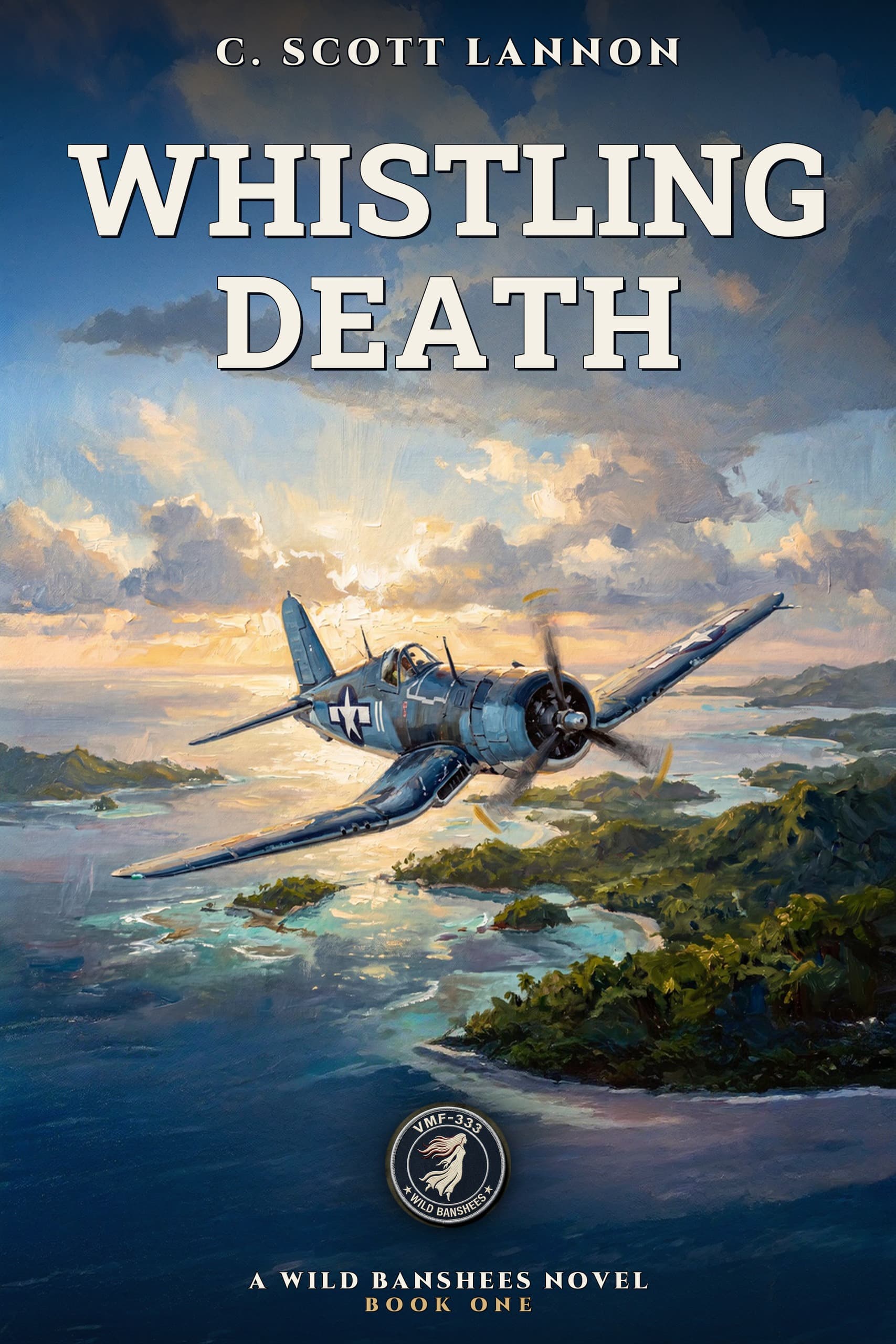
Whistling Death
A Wild Banshees Novel · Book 1
VMF-333 “The Wild Banshees” is a hastily assembled squadron of Marine fighter pilots flying F4U Corsairs from dirt strips in the Solomon Islands, 1943. The worst assignment in the Pacific Theater, given to the pilots nobody else wanted.
As they fight the air war against Japan’s best aces, the pilots begin experiencing unexplained phenomena: phantom voices on the radio, controls that move on their own, a scent of perfume at twenty thousand feet. They call the Corsair “Whistling Death.” But the pilots of VMF-333 are starting to think something else is doing the screaming.
By C. Scott Lannon. For readers of Stephen Coonts, W.E.B. Griffin, and P.T. Deutermann.
The Wild Banshees Series
- 1. Whistling Death: Solomon Islands, 1943. Available now
- 2. The Wailing: The Central Solomons campaign. Available now on Kindle
- 3. Banshee’s Dawn: Fighter sweeps over Rabaul. Coming soon.
The Real War Behind the Fiction
The Wild Banshees are invented. The war they fly in is not.
The airplane
Vought built the F4U Corsair around the biggest engine it could get, the 18-cylinder Pratt & Whitney R-2800. To use that power it needed a propeller 13 feet 4 inches across. So Vought bent the wing down and back up, which kept the landing gear short and strong. The long nose made the deck hard to see on landing, and the Navy held the early Corsairs back from its carriers. The Marines took them to land bases in the Solomon Islands instead. VMF-124 flew the Corsair into combat for the first time in February 1943. That is the world the Wild Banshees fly in.
The name
Air rushing through the intakes in the wing roots made the Corsair whistle in a dive. The popular story says Japanese troops named it Whistling Death. No Japanese source for that has ever been found. The earliest known use of the name is in an American magazine, Time, in October 1943.
The places
Munda, Vella Lavella, Torokina on Bougainville and the Japanese base at Rabaul are real. The three novels follow the same road north that the Marine Corsair squadrons flew in 1943 and early 1944.
The squadron everyone remembers
The most famous Marine Corsair squadron of the campaign was VMF-214, the Black Sheep. Its commander, Gregory “Pappy” Boyington, posed in a Corsair with a woman’s name on the nose for a press photo. He later said the name was Lulubelle. The records say otherwise, and they say he never flew that airplane in combat.
Read the story of Lulubelle →Love WWII Aviation? Read the True Stories
The nonfiction companion to Wild Banshees. Painted for War tells the real human stories behind WWII’s most famous nose art. The mechanics who became artists. The sweethearts who became pin-ups. The junkyard manager who saved the art with axes.
Learn about Painted for War →