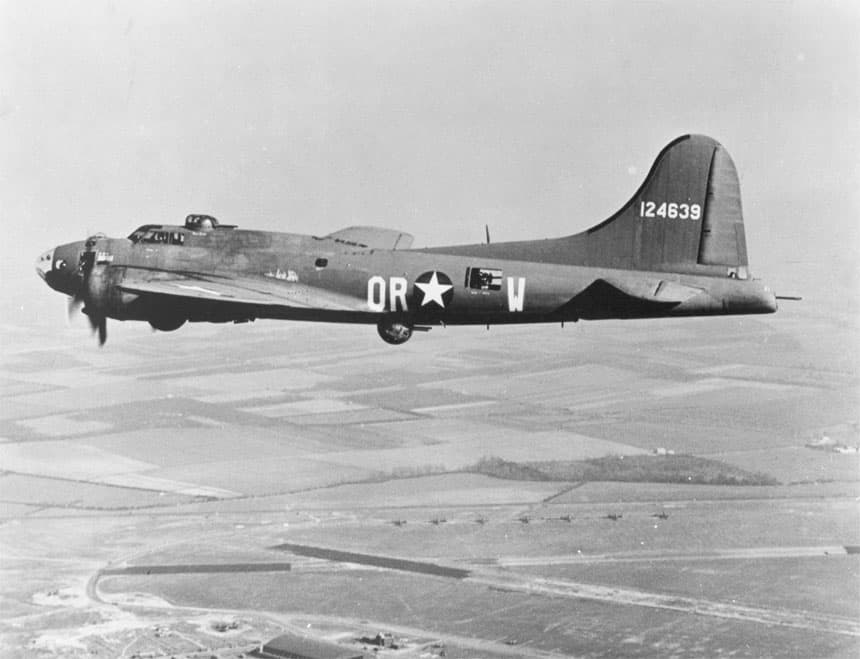
Nine-O-Nine
B-17G-30-BO · 42-31909
A B-17 that flew 140 combat missions and brought every crew home, named for nothing more than the last three digits of its serial number.
The name was an accident of arithmetic. When a Boeing B-17G-30-BO rolled off the Seattle line in early 1944 it carried the serial number 42-31909, and somewhere in the process of assigning it to a crew the last three digits stuck. Nine-O-Nine. No pin-up gave it the name. No sweetheart, no hometown, no inside joke about a movie. Just a number read off the data block on the fuselage. The most decorated workhorse in the Eighth Air Force was named the way a warehouse names a pallet.
The aircraft was delivered on February 24, 1944, and assigned to the 91st Bombardment Group, 323rd Bomb Squadron, at Bassingbourn in the flat farm country north of London. The 91st called itself "The Ragged Irregulars," and by the winter of 1944 it was already the most photographed bomb group in the Eighth, the outfit that had sent the Memphis Belle home on a war-bond tour the previous spring. Its bombers carried the triangle-A tail marking and, on their noses, the work of one man. Corporal Anthony Starcer, a line mechanic with no formal art training, had become the group's resident artist by the simple accident of being able to paint a woman on aluminum. By the time Nine-O-Nine arrived, Starcer had already put his brush to well over a hundred of the group's Fortresses. He worked with thinned house paint on an open flight line in English cold, and he could finish a nose in a day.
The airplane went to war the day after it arrived. Its first combat mission was February 25, 1944, against the Messerschmitt works at Augsburg. It would not stop for fourteen months.
To understand what Nine-O-Nine did, you have to understand the arithmetic it was flying against. In 1943 and into 1944, a B-17 over Germany was one of the most dangerous places a young American could be. Flak fields the size of cities. Fighters that came in head-on at closing speeds near 500 miles per hour. A bomber tour ran twenty-five missions, then thirty, then thirty-five, and for long stretches of the campaign the odds of finishing one were worse than a coin flip. Bombers did not age. They were shot down, cannibalized, written off, or fed into the smelter. A Fortress that survived thirty missions was an old soldier. A Fortress that survived fifty was a legend.
Nine-O-Nine flew 140.
The number is believed to be the Eighth Air Force record for combat missions flown without the loss of a single crewman to enemy action. State that carefully, because the men who kept the records did. The claim is not that the airplane was never hit. It was hit constantly. The claim is that across 140 trips into the most heavily defended airspace on earth, every man who climbed aboard Nine-O-Nine climbed back out. Flak tore through the skin, engines were shot out and swapped, panels were cut away and replaced, and still the aircraft brought its crews down onto the runway at Bassingbourn. Group historian Marion Havelaar recorded a second record alongside the first: somewhere between 126 and 132 of those missions were flown consecutively without a single abort for mechanical failure. The airplane did not turn back. It went where it was sent and it came home.
The maintenance logs read like a ledger of attrition survived. Twenty-one engine changes. Four wing panel changes. Fifteen main fuel tank changes. Eighteen changes to the long-range "Tokyo tanks" in the wings. Across its career the aircraft logged 1,129 hours in the air and dropped roughly 562,000 pounds of bombs, better than 250 tons, on targets across occupied Europe. Eighteen of those missions were to Berlin, the deepest and most defended target the Eighth flew, the one the crews called "Big B." Every one of those Berlin trips was a maximum-effort gamble, and every one of them Nine-O-Nine survived.
None of this happened in the air alone. A B-17 that never aborted for mechanics was, in a strict and unglamorous sense, a monument to the men on the ground. Master Sergeant Rollin L. Davis was the aircraft's maintenance line chief, and the record he built with a wrench in the English weather earned him the Bronze Star. This is worth sitting with. The medal did not go to a gunner or a pilot. It went to the crew chief who kept an airframe flying through 140 missions and more than a thousand hours without a mechanical failure serious enough to scrub a mission. The men who flew Nine-O-Nine trusted their lives to Davis and his ground crew every time the props turned over on a cold morning, and the trust was never once misplaced.
Somewhere in that run, on the flight line at Bassingbourn, Starcer painted the nose. The lettering, in the group's familiar style, spelled out the number that had already named the airplane. Starcer signed almost none of his work and was paid for none of it. His name appears today on the museum plaques and the acquisition notices, but during the war he was a corporal with a paintbrush who touched more B-17s than any other artist in the conflict, and Nine-O-Nine was one of the roughly 130 that carried his hand into combat. The morale value of that was not incidental. In a bomb group where the odds were what they were, a marked airplane was a talisman, and a marked airplane that kept coming home was something closer to a patron saint.
The war in Europe ended, and the arithmetic reversed. The airplanes that had been irreplaceable in 1944 were, by the summer of 1945, surplus. Nine-O-Nine was flown back to the United States on June 8, 1945. It went the way nearly all of them went. On December 7, 1945, four years to the day after Pearl Harbor, the aircraft was scrapped at the great storage and smelting yard at Kingman, Arizona, where thousands of surplus warbirds were lined up in the desert and fed into the furnaces for their aluminum. The most successful B-17 in the Eighth Air Force, the airplane that brought every one of its crews home across 140 missions, was reduced to ingots. There is no wreck to visit. There is no restored original in a museum hangar. The record survived. The airplane did not.
And this is where the story splits, because the name did not die with the airframe. It came back on a different airplane, and that second life is the reason most people type "Nine-O-Nine" into a search bar today.
The aircraft the public came to know as Nine-O-Nine for more than three decades was not 42-31909. It was a Douglas-built B-17G-85-DL, serial number 44-83575, that came off the Long Beach line on April 7, 1945, too late to fire a shot in the war. It never saw combat. It served in air-sea rescue into the early 1950s, sat close enough to a nuclear test during Operation Tumbler-Snapper to absorb the blast as an instrumented target, and was eventually sold as surplus and flown for years as a fire bomber, dropping borate on wildfires. In January 1986 the Collings Foundation of Stow, Massachusetts, acquired the airframe. They restored it, registered it as N93012, and painted it in the markings of the 91st Bomb Group as a flying tribute to the wartime original. For the next thirty-three years it toured the country as part of the Wings of Freedom tour, one of a small handful of airworthy Flying Fortresses left in the world. Hundreds of thousands of people walked through its fuselage. Tens of thousands paid to ride in it. For a generation of Americans, this airplane was Nine-O-Nine, and the distinction between the tribute and the original blurred until, for most people, it disappeared.
On the morning of October 2, 2019, the Collings Nine-O-Nine took off from Bradley International Airport at Windsor Locks, Connecticut, on a "living history flight experience," a paid pleasure flight with ten passengers and three crew aboard. Minutes after takeoff the pilot radioed the tower reporting a problem with the engines and requested an immediate return. The airplane never made the runway. It came down short, struck the approach lighting and a de-icing fluid tank, and burned. Seven of the thirteen people aboard were killed, including the pilot, Ernest McCauley, who was seventy-five and served as the Foundation's director of maintenance, and the co-pilot, Michael Foster, seventy-one. Others aboard were badly burned. One person on the ground was injured.
The National Transportation Safety Board released its findings in April 2021. The probable cause was the pilot's failure to properly manage the airplane's configuration and airspeed after he shut down the number 3 and number 4 engines, compounded by the Collings Foundation's ineffective safety management system and inadequate Federal Aviation Administration oversight of that system. Investigators tearing down the engines afterward found spark plugs worn beyond specification and magnetos in poor condition on the very engines that had failed, despite an inspection less than a month before the crash. The aircraft that had survived a nuclear test and thirty-three years of touring was destroyed not by enemy fire, which it never faced, but by the slow accumulation of deferred maintenance.
The two airplanes deserve to be kept straight, and the keeping-straight is itself the point. The original Nine-O-Nine, 42-31909, flew 140 combat missions over Nazi Germany, brought every crewman home alive, and was quietly melted down in the Arizona desert in 1945 with no one watching. The tribute Nine-O-Nine, 44-83575, never saw combat, carried the original's name for thirty-three years, and died in a fireball in Connecticut in front of a control tower and a nation's news cameras. The record belongs to the airplane no one remembers. The wreckage belongs to the airplane everyone searches for. Tony Starcer's brush touched only the first of them. The second wore his design as a costume, the way the restored Memphis Belle in Dayton wears a Petty girl that Starcer never painted.
What endures is the number. Nine-O-Nine was named for nothing, a scrap of a serial read off a data plate, and it turned that nothing into the best survival record a heavy bomber ever compiled in the European war. Every man who flew her lived. The crew chief who kept her flying wore a Bronze Star for it. And then, like almost all of them, she was gone before anyone thought to save her.
Frequently Asked Questions
- How many missions did the B-17 Nine-O-Nine fly?
- The wartime Nine-O-Nine flew 140 combat missions with the 91st Bomb Group, believed to be the Eighth Air Force record, without losing a single crewman to enemy action.
- Why was it called Nine-O-Nine?
- It was named for the last three digits of its serial number, 42-31909. Unlike most bombers, it was not named for a person, a sweetheart, or a slogan.
- What happened to the original Nine-O-Nine?
- The wartime original was flown back to the United States after V-E Day and scrapped at Kingman, Arizona, on December 7, 1945. No part of the original aircraft survives.
- Was the Nine-O-Nine that crashed in 2019 the original?
- No. The aircraft that crashed at Bradley Airport, Connecticut, on October 2, 2019 was a separate airframe (44-83575) restored by the Collings Foundation as a flying tribute. It was built too late to see combat and carried the Nine-O-Nine name for 33 years.
- Who painted the Nine-O-Nine nose art?
- Cpl. Tony Starcer, the 91st Bomb Group's resident artist, who painted the nose art on roughly 130 B-17s including the Memphis Belle.
Next Story
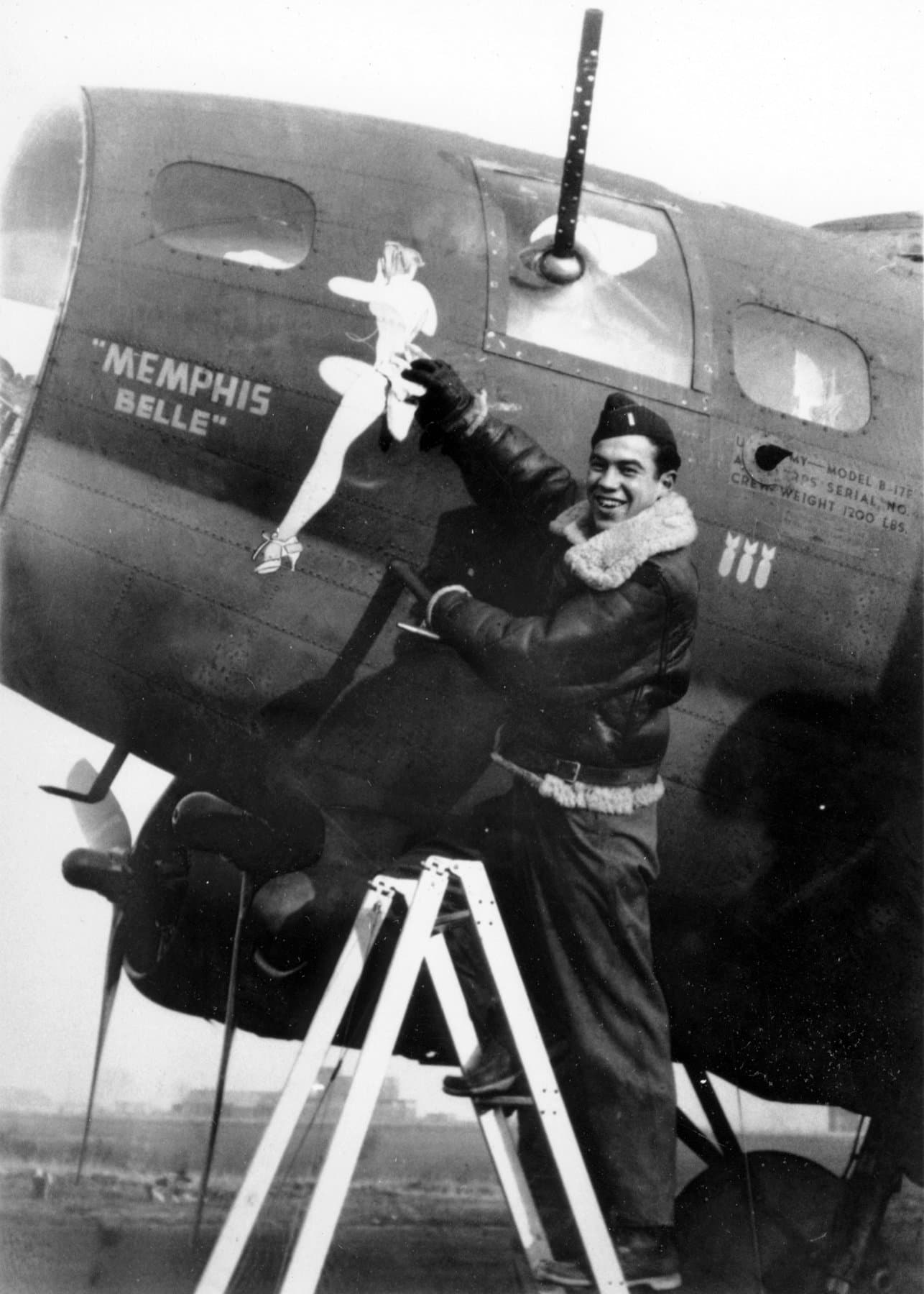
Memphis Belle
The most famous bomber of World War II carries a pin-up nobody posed for, painted by a mechanic who gave up art after the war.
Read the story →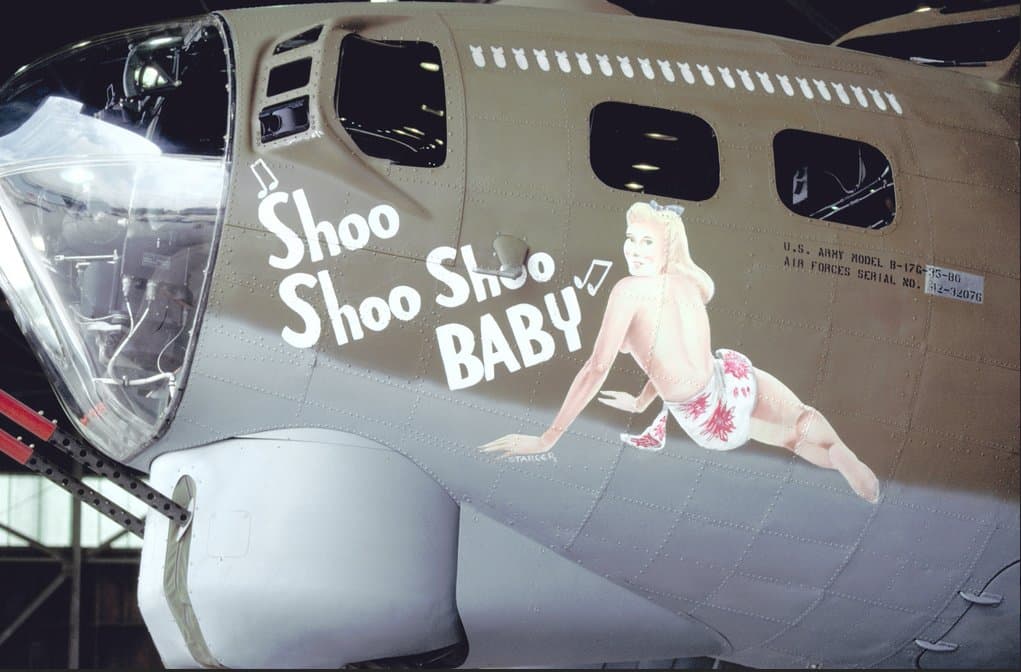
Shoo Shoo Baby
A bomber that traveled from England to Sweden to France to Germany to America. Its artist returned after 36 years to repaint it.
Read the story →