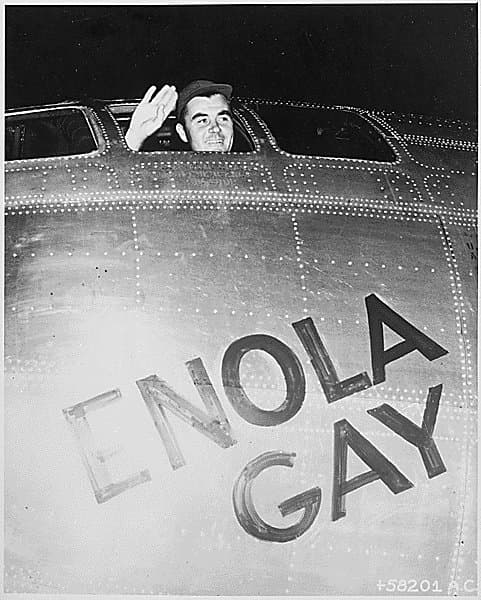
Enola Gay
B-29 Superfortress · 44-86292
The most consequential aircraft in history carries the simplest possible nose art: a name, in plain black letters.
Colonel Paul W. Tibbets did not name his B-29 until the night before the mission. He had spent the preceding year running the most secret bomb group in the Army Air Forces — the 509th Composite Group, fifteen handpicked crews moved from Fairmont Army Airfield in Nebraska to Wendover Army Airfield in Utah, then to North Field on the island of Tinian — and he had let his airplane fly without a name through all of it. The 509th had, in fact, been ordered to apply no nose art to its aircraft on Tinian. The unit's existence depended on going unnoticed by the other B-29 groups already operating from the same island. Tibbets watched, on the evening of August 5, 1945, as the weapon designated "Little Boy" was loaded into the bomb bay of his aircraft. He looked at the unpainted nose and made a decision. He named the airplane after his mother, Enola Gay Tibbets, who had supported his choice to fly when his father had wanted him in medical school. He sent for an enlisted man from the 509th named Allen Louis Karl. Karl drew the maps that navigators used on bomb runs; he doubled as the unit's unofficial sign painter. He came down to the hardstand that night, climbed a ladder against the forward port fuselage of B-29 serial 44-86292, and painted his commander's mother's name in simple black block letters under the pilot's window. There was no time for anything else. The plane took off the following morning.
That is the bare timeline. What it omits is the discipline of secrecy that made the lettering on the Enola Gay possible. The 509th had been organized in late 1944 under a code word — Silverplate — that gave Tibbets and his procurement officers authority to requisition almost anything they asked for. Tibbets later observed, in a newspaper interview, that "nobody in the future will ever be given the responsibility and authority that was given to a 29-year-old man. Today four-star generals have less authority than I had then." The 509th's training base at Wendover was on the Utah salt flats, well away from the population centers, near a small rural town. A sign at the front gate told the men what they were inside: "WHAT YOU HEAR HERE — WHAT YOU SEE HERE — WHEN YOU LEAVE HERE — LET IT STAY HERE!" FBI agents watched the airmen on base, followed them on weekend passes to Salt Lake City, and tracked them while they were home on leave. Men who got drunk, gave their friends tours of their B-29s, or talked at all about what they did during the day were transferred out, often overnight. Rumors said they were sent to Alaska. The 509th's bomb-load training used 10,000-pound conventional weapons known as "pumpkin" bombs — single-bomb shapes that approximated the size and weight of what the 509th would actually be asked to drop.
The 509th began deploying to Tinian in May 1945. Conditions there increased the secrecy rather than relaxing it. The unit's Quonset huts on Tinian's North Field were the best on the island and were surrounded by a barbed-wire fence. Curious airmen from other B-29 groups were kept out; the 509th was kept in. The 509th's silver B-29s flew training missions later in the day, after the rest of the island's bombers had already departed on combat raids. They climbed to extreme altitude, dropped occasional single high-explosive bombs over enemy territory, and came home. The other groups watched them sleep in, fly easy, and lose nothing. Songs and limericks circulated on Tinian to the effect that the 509th was winning the war by staying out of it. The aircraft commander of the 509th's lead crew on the first mission later said of the period that he and his crewmen had been called "the laughingstock" of the airfield. Jeeps passing the 509th's Quonset huts at night would throw rocks onto the tin roofs.
This is the context in which the Enola Gay's nose art carries its meaning. Almost every other operational B-29 group on Tinian had crews competing to put pin-up girls, animals, and slogans on their nose panels. The 509th had been forbidden to do so. When Tibbets made the night-before decision to put his mother's name on the nose, what he was authorizing was not a deviation from the security regime but a small breach of it — a personal mark made permissible only because the secret was about to be made public. Aircraft Commander Maj. Charles W. Sweeney's airplane, The Great Artiste, and Aircraft Commander Capt. Frederick C. Bock's airplane, the one later named Bockscar, would not get their own nose art until after the atomic missions were flown. The 509th's other planes — Strange Cargo, Full House, Top Secret, Jabbit III, Some Punkins, Necessary Evil — received their paint and their names in the August and September weeks that followed, when the secrecy lifted and the men finally had permission to behave like a bomber group. The Enola Gay was first, and the lettering on it was thinnest, because it had to be done in the dark, against the rules of the unit, before sunrise.
The aircraft itself was not a stock B-29. It was a Silverplate — a specialized variant of the Superfortress, of which only fifteen were modified to carry an atomic weapon during the war and only 145 were built in total during the production run that followed. The Silverplate program produced the bombers that the 509th needed by stripping out almost everything that did not relate to the mission. Most of the defensive armament was removed. The fuselage was reinforced to handle a single bomb of approximately 10,000 pounds. The bomb bay was reconfigured to British weapon-suspension specifications because the original Little Boy and Fat Man weapons would not fit the standard American B-29 fittings. New propellers with reversible pitch were installed to shorten the landing roll. Modified engines allowed the aircraft to cruise above 30,000 feet at roughly 260 miles per hour with a payload of 10,000 pounds across a range of more than 2,000 miles. The first of these aircraft began arriving at Wendover in April 1945. The Enola Gay — Boeing factory serial 44-86292 — was one of them, and it was the first Silverplate B-29 to be painted with a name.
The Hiroshima mission itself happened almost exactly as the planners had hoped, in the technical sense of "happened." The Enola Gay took off from Tinian at approximately 2:45 a.m. local time on August 6, 1945, carrying a single weapon that weighed approximately 9,700 pounds — a uranium gun-type assembly designated Little Boy. The aircraft commander was Tibbets. The bombardier was Major Thomas Ferebee. The mission was preceded over the target by a 509th weather plane, Straight Flush, which flew thirty-five minutes ahead of the strike aircraft to confirm clear skies over Hiroshima. At 8:15 a.m. Hiroshima time, the Enola Gay released the weapon at an altitude of approximately 31,000 feet. The B-29 banked sharply away. The bomb fell for about forty-three seconds and then detonated above the city. The crew flew home. The Enola Gay landed at Tinian shortly before three o'clock that afternoon. Tibbets was awarded the Distinguished Service Cross on the tarmac before he had gotten out of the airplane. The men spent the next forty-eight hours largely in their Quonset huts.
What the technical narrative does not capture is the silence inside the 509th that began once the mission was acknowledged publicly. The unit had been operationally an invisible group on Tinian; with the announcement of the bomb, individual men became publicly attached to an event that none of them had been allowed to discuss with anyone outside the wire. Tibbets, in later memoirs and interviews, described the secrecy period at Wendover and Tinian as "nerve-shattering" and said it eventually broke his first marriage. He also pushed back against the way the historical record framed his crew, observing that "it took every man of the 509th to put those airplanes into the air. Each, not just a select few, played a part and should be recognized for their individual part." Crewmen from Straight Flush, The Great Artiste, and the other 509th aircraft would spend much of the rest of their lives in the position of being known for a mission they had supported but not flown, of being part of an event whose names had been collapsed in the press into Tibbets's and the Enola Gay's.
Three days later, on August 9, 1945, Major Charles W. Sweeney and his crew took off from Tinian in a B-29 borrowed from Bock's regular crew. The aircraft was Bockscar — pilot Frederick Bock's airplane, named as a pun on his name and on the freight railroad cars that had carried the weapon components from Salt Lake City and Wendover toward the Pacific. The bombardier was Captain Kermit K. Beahan. The target was Kokura. Smoke and weather obscured the city. Sweeney diverted to the secondary target, Nagasaki, and released the weapon there at 11:02 a.m. local. The nose art on Bockscar — a winged boxcar dropping a bomb, with the name in graffiti-style lettering — was painted in the days after the mission, by T/Sgt. Port Richardson, a 393rd Bomb Squadron radar countermeasures line chief. Like every other piece of nose art on the 509th's aircraft, it was retroactive. The aircraft that bombed Nagasaki carried no nose art when it took off and was named after a pilot who was not on it.
The August 20, 1945 issue of Life magazine introduced America to the men who had flown the missions. The magazine ran the names and the faces. It also got the second mission wrong: it reported that The Great Artiste, Sweeney's regular airplane, had dropped Fat Man on Nagasaki. The mistake was understandable. Sweeney's normal aircraft was The Great Artiste; he had flown Bockscar that day because The Great Artiste had been configured as the instrumentation aircraft for the Hiroshima mission three days earlier and was still rigged for that role. Life's error followed the airplanes into the historical record. For decades the wrong aircraft was nearly memorialized at the National Museum of the United States Air Force as the bomber that struck Nagasaki, before the correction stuck. Bockscar is now displayed at Dayton. The Great Artiste was scrapped in 1949.
The Enola Gay's post-war fate was a long story in three parts. The first part was disposal. The aircraft was flown to Davis-Monthan Air Force Base in Arizona on September 1, 1946, with the rest of the surplus B-29 inventory. It sat there until July 3, 1949, when Tibbets himself flew the airplane to Orchard Place Air Field at Park Ridge, Illinois, and formally turned it over to the Smithsonian Institution. The Smithsonian had agreed to take the aircraft as a museum piece but had nowhere to put it. The Enola Gay was moved from Park Ridge to Pyote Air Force Base in west Texas in January 1952, and then in December 1953 to Andrews Air Force Base in Maryland, where it was hoped the Air Force would protect the airframe. Andrews did not have a hangar that would hold it. The B-29 sat outdoors on a remote stretch of the field for the rest of the 1950s, exposed to weather and to souvenir-hunters who broke in and removed instruments and other parts. By the time Paul E. Garber of the Smithsonian's restoration staff intervened, the aircraft was visibly deteriorating. On August 10, 1960, Smithsonian crews began disassembling the airframe in place at Andrews. The components were trucked to the Smithsonian's storage facility at Suitland, Maryland — the building that would eventually be named the Paul E. Garber Preservation, Restoration, and Storage Facility — and the Enola Gay essentially disappeared from public view for the next quarter century.
The second part was restoration. Work began at the Garber Facility on December 5, 1984. It would consume approximately 300,000 staff hours and roughly nineteen years. Restorers reassembled the airframe in sections inside the cramped Garber buildings, working on one segment at a time. By the mid-1990s the forward fuselage — the section bearing the painted name and the bomb-bay doors — had been finished and was ready for public display. Around that work, the second story crystallized: the controversy over the exhibition itself.
In 1993 the Smithsonian's National Air and Space Museum on the National Mall began planning a fiftieth-anniversary exhibit on the end of the war in the Pacific, with the restored forward fuselage of the Enola Gay as its centerpiece. Drafts of the exhibit text by NASM curators framed the bombing in terms that veterans' groups, military historians, and members of Congress regarded as morally accusatory rather than historically straightforward. A two-year battle followed. Curatorial drafts were revised. Veterans testified. The Air Force Association issued statements. The original exhibit script was withdrawn and reworked multiple times. In the end, NASM canceled the conceptual exhibit. The aircraft's forward fuselage went on display in 1995 in a sharply pared-down version that the museum's then-director described, with notable understatement, as a display of the fuselage with minimal historical context — a compromise that satisfied no one on any side. The fight is a milestone in the public history of how the United States talks about the bomb. Most accounts of the Enola Gay still treat it as part of the airplane's biography.
The third part was the move to Udvar-Hazy. The remaining sections of the airframe were finished at Garber in the late 1990s and early 2000s, and the entire B-29 was reassembled at the Smithsonian's new Steven F. Udvar-Hazy Center in Chantilly, Virginia, between March and June 2003. The Udvar-Hazy Center opened to the public on December 15, 2003 — the centenary of the Wright brothers' first powered flight at Kitty Hawk — with the fully restored Enola Gay as the anchor of its World War II aviation collection. The 1995 fuselage display had shown only a fragment. The Udvar-Hazy installation shows the entire aircraft. The Hangar 1 floor space allows visitors to walk completely around it. The bomb bay doors are open. The lettering on the lower port nose, painted by Karl Allen the night before the mission, has been reproduced to match the wartime configuration. There is nothing else on the aircraft's exterior: no pin-up, no slogan, no mission marks. There is the name of Tibbets's mother, and there is the airplane.
Paul Tibbets died on November 1, 2007, at his home in Columbus, Ohio. He was ninety-two. He had spent six decades giving interviews about the mission and had not deviated from a single position: that the bomb had been a military decision under the rules of total war, that he had been ordered to drop it, and that he did not regret the order or its outcome. He instructed his family that he was to be cremated, that there was to be no funeral and no headstone, and that his ashes were to be scattered over the English Channel. He gave the reason explicitly: he did not want his grave to become a focus for protesters of the mission he had flown. The decision is unusual among American flag officers and is consistent with everything else about the way Tibbets handled the public part of his career. He kept the airplane simple. He kept the burial simple. He let other people argue about the meaning. The veterans of the 509th held organized reunions through 2017, gathering the surviving aircrew and ground personnel each year — a small group that, by the end, was largely the children and grandchildren of the original men. The reunions outlasted most of the airmen, and the families have continued to gather informally even after the formal association wound down.
The Enola Gay sits today at Udvar-Hazy in the same configuration it carried on the morning of August 6, 1945. The aircraft is the most carefully restored B-29 in the world. The lettering under the pilot's window is plain black paint applied to bare aluminum. No pin-up. No cartoon. No dragon. No shark mouth. Just a name. The most consequential aircraft in the history of aviation has on its forward fuselage exactly what a 29-year-old colonel could order an enlisted sign-painter to write in the last few hours before sunrise, when there had not been time, or permission, for anything else.
Frequently Asked Questions
- What is the Enola Gay?
- The B-29 Superfortress that dropped the 'Little Boy' atomic bomb on Hiroshima on August 6, 1945, flown by Colonel Paul Tibbets of the 509th Composite Group.
- Who was the Enola Gay named after?
- Colonel Paul Tibbets named it the night before the mission after his mother, Enola Gay Tibbets. An enlisted sign-painter lettered the name in plain black block letters.
- Why is the Enola Gay's nose art so plain?
- The 509th had been ordered to apply no nose art so it would go unnoticed. Tibbets's last-minute lettering was a small breach as the secret was about to become public: just a name, no pin-up.
- Where is the Enola Gay now?
- On display at the Smithsonian's Steven F. Udvar-Hazy Center in Chantilly, Virginia, after a restoration of roughly 300,000 staff hours.
Next Story
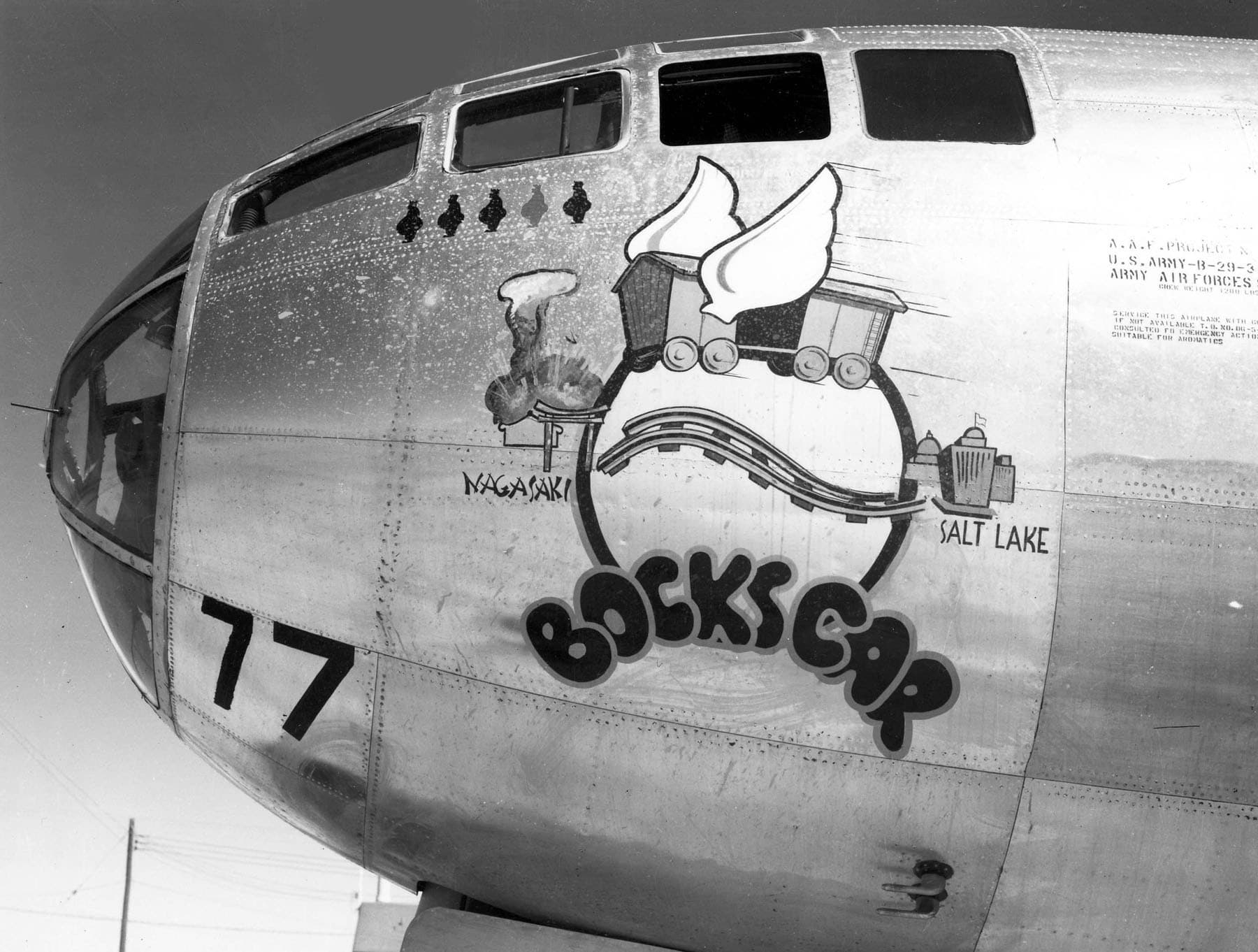
Bockscar
The bomber that ended the war almost did not survive the mission. Bockscar dropped Fat Man on its secondary target and landed on fumes.
Read the story →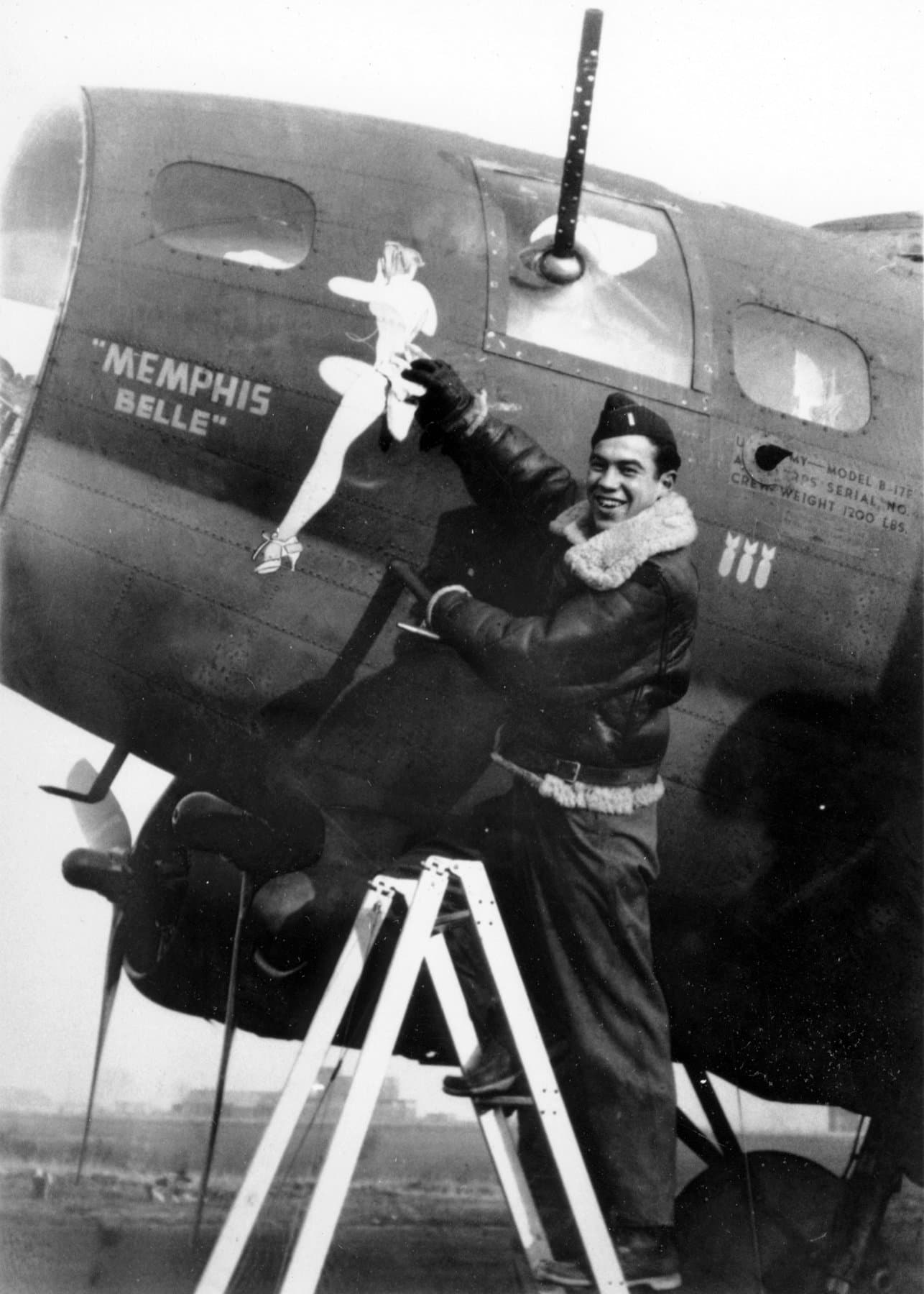
Memphis Belle
The most famous bomber of World War II carries a pin-up nobody posed for, painted by a mechanic who gave up art after the war.
Read the story →