Bockscar
B-29 Superfortress · 44-27297
The bomber that ended the war almost did not survive the mission. Bockscar dropped Fat Man on its secondary target and landed on fumes.
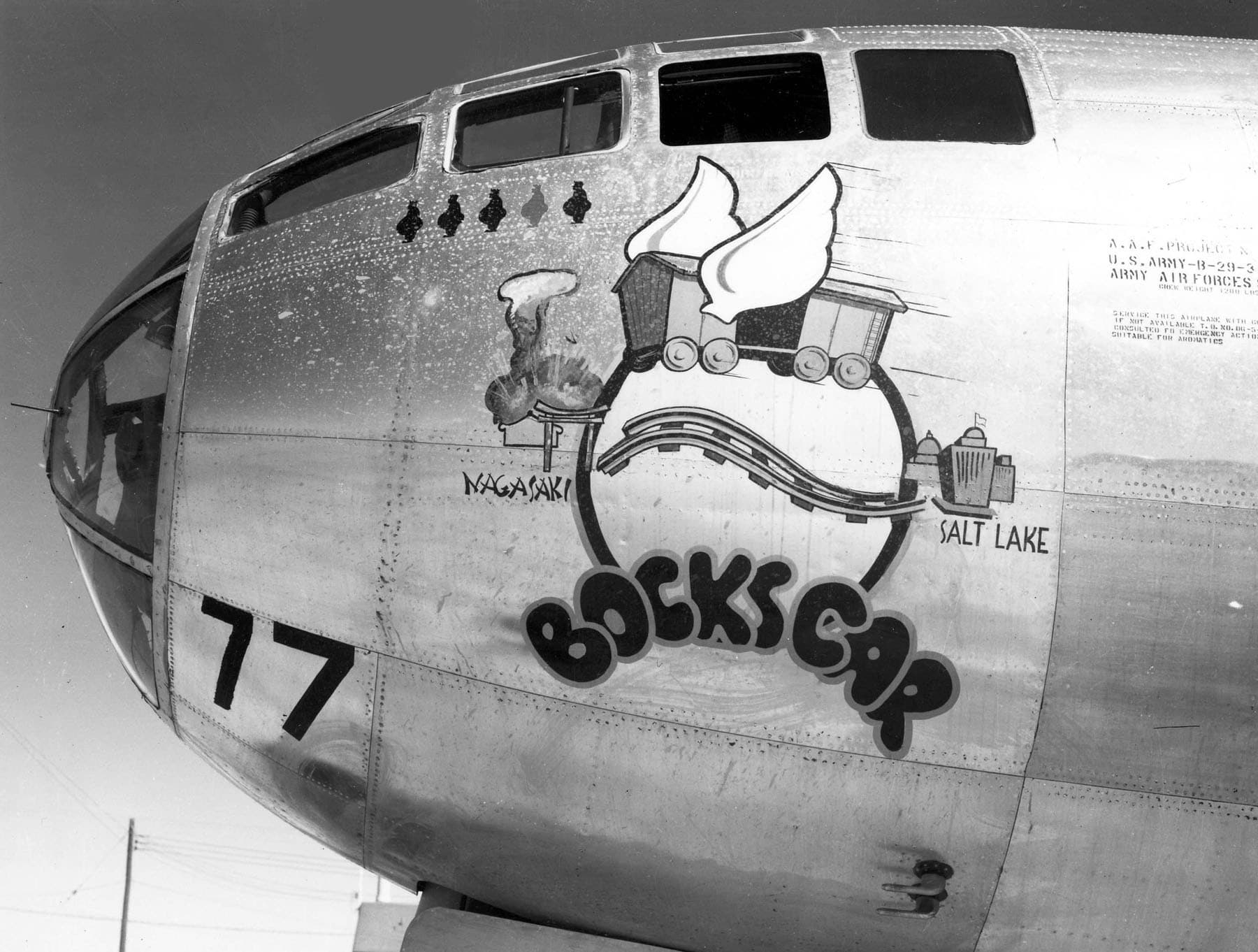
The problem was a fuel pump, and the ground crew found it before dawn. On the hardstand at North Field, Tinian, in the early hours of August 9, 1945, a pre-flight inspection of B-29 serial 44-27297 turned up an inoperative transfer pump in the tail. The defect trapped 640 gallons of fuel in a reserve tank. The gasoline was aboard the aircraft. It could not be moved to the engines. The mission commander, Major Charles W. Sweeney of the 393rd Bomb Squadron, was told he could scrub, wait for repairs, and lose the weather window, or he could fly a nine-hour round trip to Japan carrying more than half a ton of fuel he would never be able to burn. He decided to go. The airplane was Victor 77. It carried no name on its nose that morning, and no art. Both would be painted on later, on Tinian, after the fact, by T/Sgt. Port Richardson, a radar countermeasures line chief in the 393rd who lettered most of the 509th's aircraft once the secrecy lifted.
The airplane did not belong to Sweeney. It was Capt. Frederick C. Bock's aircraft, and the name it would later carry, Bockscar, was a pun on Bock's name and on the railroad boxcars that had hauled the weapon components toward the Pacific. Sweeney's own aircraft was The Great Artiste, which three days earlier had flown to Hiroshima rigged as the instrumentation ship for the Enola Gay and was still full of blast-measurement gear. So the two commanders traded. Sweeney took Bock's airplane to carry the bomb. Bock took Sweeney's airplane and flew it as the observation aircraft. Each man flew the other's B-29 to Nagasaki, and the confusion that arithmetic produced would follow both airplanes for decades. The relevant fact on the morning of August 9 was simpler. The strike aircraft was Bockscar, and it was flying to Japan with a fuel system it could not fully use.
The weapon in the bomb bay was not the weapon the Enola Gay had carried. Little Boy had been a uranium gun-type device, long and slim. Fat Man was a plutonium implosion bomb, and it looked the part: a bulbous steel egg roughly ten feet long and five feet across, weighing approximately 10,300 pounds, its skin studded with the boxes and cables of a firing system that had never been used in combat. Inside, a sphere of plutonium was wrapped in precisely shaped explosive lenses designed to crush the core inward in millionths of a second. The physics had been proven exactly once, at Trinity in the New Mexico desert three weeks earlier. The weaponeer aboard Bockscar, Cmdr. Frederick Ashworth of the Navy, and his assistant, Lt. Philip Barnes, were responsible for arming the device in flight. Also aboard was 1st Lt. Jacob Beser, an electronic countermeasures officer and the only man who flew on the strike aircraft for both atomic missions.
Bockscar lifted off from North Field at 3:49 a.m. Sweeney climbed to a cruising altitude of 17,000 feet rather than the customary 9,000, a decision that saved wear on the engines but changed the fuel math again. The plan called for a rendezvous over the small island of Yakushima with two observation aircraft. One of them, The Great Artiste, found the formation. The third, an aircraft named Big Stink carrying scientific observers and photographic equipment, did not. Sweeney orbited Yakushima waiting for it, circling for roughly 40 minutes while the trapped 640 gallons rode uselessly in the tail. The delay burned fuel he did not have to spare. He finally turned for the primary target without the third airplane.
The primary target was Kokura, and the aiming point was the Kokura Arsenal, one of the largest arms plants in Japan. Bockscar arrived to find the city obscured. The day before, American bombers had firebombed nearby Yahata, and smoke from those fires had drifted across Kokura and mixed with haze and cloud until roughly seventy percent of the target area was hidden. The bombardier, Capt. Kermit Beahan, needed a visual on the aiming point. His orders were explicit: the weapon was to be dropped by sight, not by radar. Sweeney made a bomb run. Beahan could not find the aiming point through the smoke. Sweeney came around and made a second run from a different heading. Nothing. He made a third. By now Japanese antiaircraft fire was reaching the aircraft's altitude and fighters were climbing toward the formation. Three runs over Kokura consumed close to fifty minutes and a great deal of gasoline. Beahan never got his aiming point. The city that had been Kokura's target list would spend the rest of the century known for what did not happen to it.
Sweeney and Ashworth conferred over the interphone. The fuel state was now critical. Ashworth, who under his orders held authority over the weapon, agreed to divert to the secondary target and to accept a radar-aided approach if the city was closed in. They turned south for Nagasaki, roughly a hundred miles away, and arrived to find that city covered too, an estimated eight-tenths cloud. Sweeney began a radar run against his orders because there was no longer fuel for anything better. In the last twenty seconds before release, Beahan found a hole in the clouds. He took the drop visually. Fat Man fell away from Bockscar at 11:02 a.m. local time, from high altitude, over the Urakami valley in the northern part of the city. The bomb detonated approximately 1,650 feet above the ground with a yield of about 21 kilotons. The aiming point had drifted from the city center to an industrial district that held two large Mitsubishi armament plants. Roughly 35,000 people were killed and some 60,000 injured. The valley walls contained the blast and spared parts of the city the topography would otherwise have exposed. The crew photographed the cloud and turned for home.
Home was not reachable. The delays over Yakushima and Kokura, the extra bomb runs, and the 640 gallons still locked in the tank had left Bockscar without enough fuel to reach the emergency field on Iwo Jima. Sweeney set course instead for Okinawa, where American forces had captured Yontan airfield only weeks before. The flight engineer, M/Sgt. John Kuharek, worked the fuel figures and kept revising them downward. As the airplane approached Yontan, Sweeney radioed for landing clearance and got no answer. He had one landing attempt in the tanks and no time to circle. He fired every distress flare aboard the aircraft to signal an emergency and force the field to clear, then brought Bockscar down hot, at roughly 150 miles per hour instead of the normal 120, to keep the heavy bomber flying on engines that were beginning to starve. The number two engine died from fuel exhaustion on final approach. The B-29 hit the runway hard, bounced, and swerved down the strip past parked aircraft before Sweeney got it stopped. When Kuharek measured what was left in the usable tanks, the figure that entered the record was about seven gallons. The airplane that dropped the second atomic bomb had come back to earth with almost nothing in it.
Sweeney refueled at Yontan, flew Bockscar back to Tinian that night, and landed to almost no notice. The Nagasaki mission had none of the choreography of the Hiroshima flight. No general met the airplane on the tarmac. No decoration was pinned before the pilot climbed down. The mission had very nearly been a disaster in the literal sense, an atomic weapon and its crew lost at sea for want of a working fuel pump, and everyone who understood the fuel figures understood how close it had come.
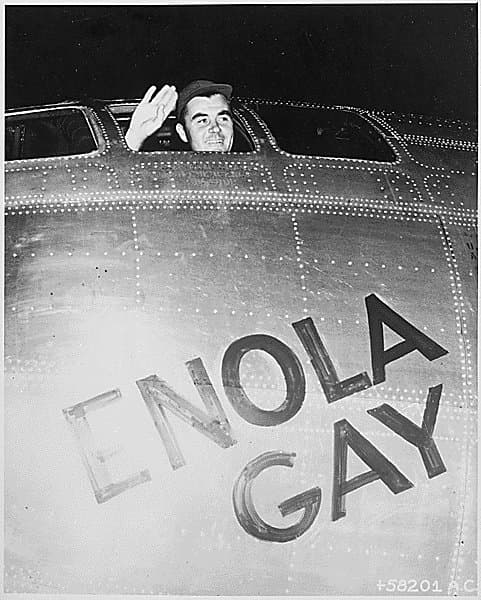
The identity confusion began almost immediately. Because Sweeney's regular aircraft was The Great Artiste, and because the airplanes had been swapped, the August 20, 1945 issue of Life magazine reported that The Great Artiste had dropped the bomb on Nagasaki. The error, covered at length in the story of the Enola Gay, sent the wrong airplane into the historical record and nearly sent the wrong airplane into a museum. For years the aircraft displayed and photographed as the Nagasaki bomber was misidentified. Bockscar was the airplane that flew the mission. The Great Artiste, which had flown as the instrument ship on both atomic strikes but had dropped neither bomb, was scrapped in 1949.
Bockscar's own survival was a matter of paperwork and neglect rather than intention. The aircraft was transferred to the Air Force Museum's collection in September 1946 and sent into storage with the surplus B-29 fleet at Davis-Monthan Field in Arizona, where hundreds of Superfortresses sat in the desert waiting to be scrapped or forgotten. It escaped the smelters. On September 26, 1961, the airplane was flown to Wright-Patterson Air Force Base in Ohio and turned over to the museum that would become the National Museum of the United States Air Force. Restorers returned it to its August 1945 configuration, and Port Richardson's nose art was reproduced on the forward fuselage: a winged boxcar in flight, a bomb riding beneath it, the route from Salt Lake City to Nagasaki lettered along the path, a mushroom cloud drawn above the city's name, and the word Bockscar itself painted in a loose, stylized hand that historians have pointed to as a forerunner of graffiti. Where the Enola Gay carried a mother's name in plain black block letters and nothing else, Bockscar carried a cartoon. The two most consequential B-29s in history sit today in two different museums with two opposite answers to the same question of what to paint on the nose of an aircraft that had just changed the world.
Bockscar stands now inside the National Museum of the United States Air Force in Dayton, restored, indoors, complete. Visitors walk under the open bomb bay and read a placard identifying it as the aircraft that ended the Second World War. The winged boxcar is bright on the aluminum. What the paint does not record is the seven gallons, the dead engine on final approach, the forty minutes wasted over Yakushima, the three failed runs over a city hidden by another day's smoke, or the 640 gallons of gasoline that rode all the way to Japan and all the way back in a tank no pump could reach. The airplane that dropped Fat Man on Nagasaki is remembered as the bomber that finished the war. It very nearly finished in the sea off Okinawa, and the margin, measured by the flight engineer after it stopped rolling, was about seven gallons.
Frequently Asked Questions
- What plane dropped the atomic bomb on Nagasaki?
- Bockscar, a B-29 Superfortress of the 509th Composite Group, dropped the 'Fat Man' plutonium bomb on Nagasaki on August 9, 1945. It was flown that day by Major Charles W. Sweeney.
- Why is the plane called Bockscar?
- The B-29 was assigned to Captain Frederick Bock, and the name is a pun on 'Bock's car' and the railroad boxcars that hauled the atomic weapon components. Bock actually flew a different aircraft on the mission while Sweeney flew Bockscar.
- Did Bockscar almost run out of fuel?
- Yes. A fuel-transfer pump failure trapped 640 gallons of fuel in a reserve tank. After a rendezvous delay and three bomb runs over the primary target of Kokura, Bockscar diverted to Nagasaki and then landed on Okinawa with about seven gallons of usable fuel remaining.
- Where is Bockscar now?
- Bockscar is on permanent display at the National Museum of the United States Air Force in Dayton, Ohio.
- What is Bockscar's nose art?
- A winged boxcar dropping a bomb, with the mission route lettered from Salt Lake City to Nagasaki. It was painted after the mission by T/Sgt. Port Richardson, a 393rd Bomb Squadron line chief.