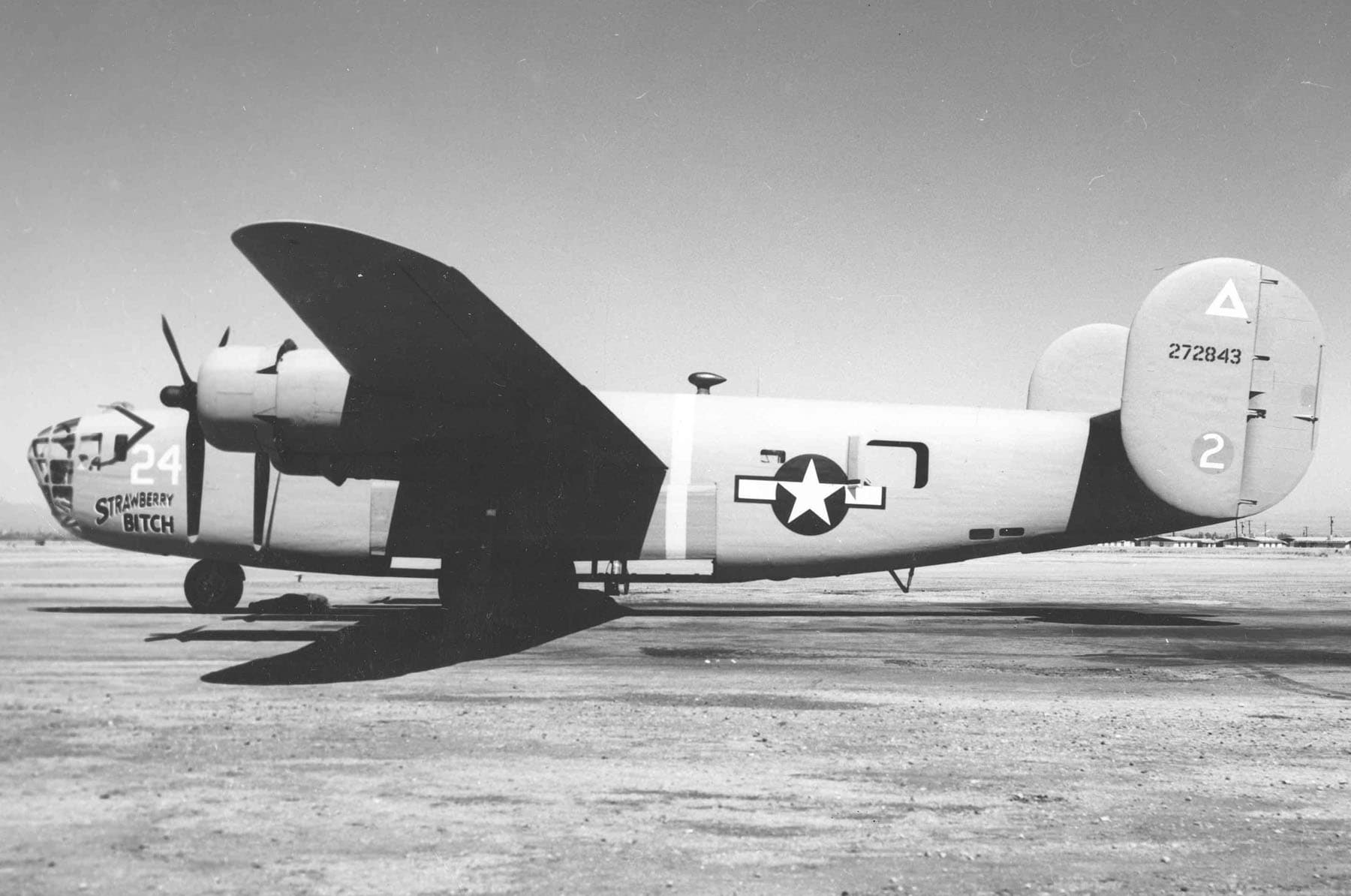
Strawberry Bitch
B-24D Liberator · 42-72843
A desert-pink B-24D that flew the Balkan oil war and came home. Consolidated built 18,493 Liberators. This is one of a handful anyone can still stand next to.
Consolidated Aircraft built 18,493 B-24 Liberators, more than any other American military airplane of the war, more than any bomber before or since. You can stand next to six of them today. The Liberator was the most-produced combat aircraft in United States history and one of the least likely to survive its own peace. Most were flown home in 1945 and 1946 to storage fields at Kingman, Arizona, and Walnut Ridge, Arkansas, where a company from Jefferson City, Missouri, fed them into furnaces that ran at 1,250 degrees around the clock and turned them into aluminum ingots at a rate of thirty-five airframes a day. An Army experiment found that dismantling a single Liberator for salvageable parts took 782 man-hours and produced 32,759 pounds of scrap that filled more than an acre of hangar floor. It was cheaper to melt them. So they melted them. The one in Dayton is here because someone decided, in 1946, that it should not go into the fire.
The airplane is a B-24D, serial number 42-72843, and it wears the color that gave it its name. It was built at the Consolidated plant in San Diego and finished in the standard Army desert scheme, a sand color meant to hide a bomber against North African ground. The sun did to the paint what the sun does. Months of Libyan and Tunisian glare oxidized the sand finish until it faded to a dull, chalky rose. The men who flew her looked at the pink airplane and named her Strawberry Bitch. On the right side of the forward fuselage, below the cockpit, a crewman painted a red-haired woman reclining on her back, one arm raised behind her head. The name went on both sides of the nose in tall script. Her recall code, the number 24, went on the nose and again on the tail so the group could sort its bombers into formation over the desert. No one signed the woman. No painter's name survives in the record, which is the ordinary fate of squadron nose art. The men who could draw drew, and the airplanes carried the work without a credit line.
She was ferried across the South Atlantic and delivered to the 376th Bombardment Group, Heavy, the outfit that called itself the Liberandos. The pilot of record for her delivery was Daniel Rice, whose crew accepted the new bomber, flew her overseas, and handed her to the group. The 376th was one of the original heavy-bomber units in the Mediterranean, part of the Ninth Air Force before the strategic bombers in the theater were consolidated into the Fifteenth Air Force in November 1943. By the time Strawberry Bitch reached the flight line, the 376th had already written the most costly page in its history.
On August 1, 1943, the 376th led Operation Tidal Wave, the low-level raid on the oil refineries at Ploesti, Romania. Ploesti supplied a third of the fuel for the German war machine, and the plan called for the Liberators to come in under the radar at rooftop height, below a hundred feet, across a target ringed with flak towers, barrage balloons, and guns hidden in haystacks and rail cars. Of the 178 B-24s that left the desert that morning, 53 did not come back. More than 500 airmen were killed, captured, or interned. Five Medals of Honor were awarded for the mission, three of them posthumously, the most for any single air action of the war. The 376th flew at the front of that formation. When Strawberry Bitch entered combat seven weeks later, on September 20, 1943, the group she joined had buried a large part of itself in the Romanian oil fields.
She flew the war the group flew after Tidal Wave. Between September 1943 and June 1944 she logged more than fifty combat missions out of North African and, later, southern Italian fields, striking targets across Italy, Austria, Greece, Bulgaria, Romania, France, and Germany. She went back to Ploesti in the 1944 campaign, when the Fifteenth Air Force returned to the refineries from high altitude, month after month, until the oil stopped. She hit marshalling yards and airfields and harbors. She came home from all of it. In an aircraft type where the arithmetic of a combat tour ran heavily against the crew, Strawberry Bitch accumulated a mission tally that most Liberators never lived to paint on their noses, and she did it in a D-model, the early Liberator, the version already being replaced by later marks with powered nose turrets while she was still flying.
The B-24D was the first Liberator built in real numbers, and it was the version that carried the American bomber war into the Mediterranean before the type became a fixture over Germany. It was a difficult airplane to love and a difficult airplane to fly. The high, narrow Davis wing that gave the Liberator its long range and heavy bomb load also made it unforgiving when it was hit, prone to fire, hard to hold in formation, harder to ditch. Crews who flew both the B-17 and the B-24 tended to speak more warmly of the Fortress. The Liberator carried more, farther, and it did the unglamorous work of the air war in the theaters that got less film. Strawberry Bitch is a D-model, and almost no D-models survived. The variant that opened the Liberator's war was gone from the sky and gone from the boneyards before anyone thought to keep one.
What kept this one was a decision made in the same season that the fires were burning at Kingman. In 1946, while thousands of her sisters were being drained of fuel and cut apart by guillotine, Strawberry Bitch was selected for preservation and flown to the storage yard at Davis-Monthan Field in Tucson, Arizona. Davis-Monthan was a boneyard like the others, a place aircraft went to wait, and waiting there was not a guarantee of anything. Aircraft chosen for a future museum sat in the desert for years alongside aircraft chosen for the smelter. But the tag on this one said keep, and the tag held. She sat in the Arizona sun, the same sun that had already turned her pink, for thirteen years.
On May 16, 1959, Armed Forces Day, she was flown from Tucson to Wright-Patterson Air Force Base in Ohio for restoration and permanent display. The last leg of the flight of the slowest bomber in the story was escorted by F-104 Starfighters, needle-nosed interceptors that could exceed twice the speed of sound, throttled back to keep pace with a piston-engine bomber from another war. The Liberator that had crossed North Africa at 200 miles an hour came into Dayton under the wings of aircraft that could have flown to Romania and back in the time it once took her to reach the target.
She is inside now, in the World War II Gallery of the National Museum of the United States Air Force, and she still wears the pink. The museum kept the desert camouflage, the faded rose finish that reads wrong to anyone who expects a bomber to be olive drab or bare aluminum, because the wrong color is the true one. The red-haired woman is still on the nose. The number 24 is still on the tail. A visitor can walk under the bomb bay, look up into the wheel wells, put a hand on the aluminum skin at the height of a man, and stand inside the actual scale of the thing, the 110-foot wing, the four radial engines, the slab sides that gunners defended with fifty-caliber guns against fighters that came at them over the Alps and the Balkans.
Six complete Liberators survive on static display in the United States. Two more can still fly. Out of 18,493, that is the count. The rest are pots and pans and window frames and the aluminum trim on postwar kitchens, or they are still lying in the Indian scrub at Chakeri and the Pacific reefs where they were bulldozed and sunk, or they went into the furnaces at Kingman with their nose art still on, the pin-ups and the dragons and the cartoon devils fed into the fire in the order the guillotine reached them. The most famous act of that destruction was the largest nose art of the war, a full-fuselage dragon painted by a Rhode Island School of Design muralist, set aside at Kingman because the scrappers could not bring themselves to cut it first, then cut last when no buyer came. That is the rule. Strawberry Bitch is the exception, and she is an exception by a margin of a paper tag in 1946.
She did nothing more spectacular than survive. She was not the first to finish a tour and she was not the most decorated and she did not have a movie made about her crew. She was a working bomber with a rude name and a sunburned coat of paint that flew the oil war and came home, and then came home again from the boneyard when the boneyard was a death sentence for almost everything parked in it. What makes her matter is what did not happen to her. In a fleet of eighteen thousand, she is one of the few that a person born in this century can walk up to and touch. The others are ingots. The desert-pink Liberator with the red-haired woman on her nose is the survivor that lets the rest be remembered.
Frequently Asked Questions
- What is the Strawberry Bitch?
- A B-24D Liberator of the 376th Bomb Group that flew the Mediterranean oil war and is now one of only a handful of surviving Liberators, on display at the National Museum of the United States Air Force in Dayton, Ohio.
- Why is the Strawberry Bitch pink?
- Its desert-sand camouflage faded under the North African sun to a chalky rose color, which is how the crew came to name the aircraft.
- Did the Strawberry Bitch fly the Ploesti raid?
- Not the famous August 1, 1943 low-level Tidal Wave raid. Her first combat mission was September 20, 1943. She flew the 1944 high-altitude Ploesti campaign with the Fifteenth Air Force.
- Where is the Strawberry Bitch now?
- On display in the World War II Gallery of the National Museum of the United States Air Force, Dayton, Ohio, still wearing its faded desert-pink finish.
Next Story
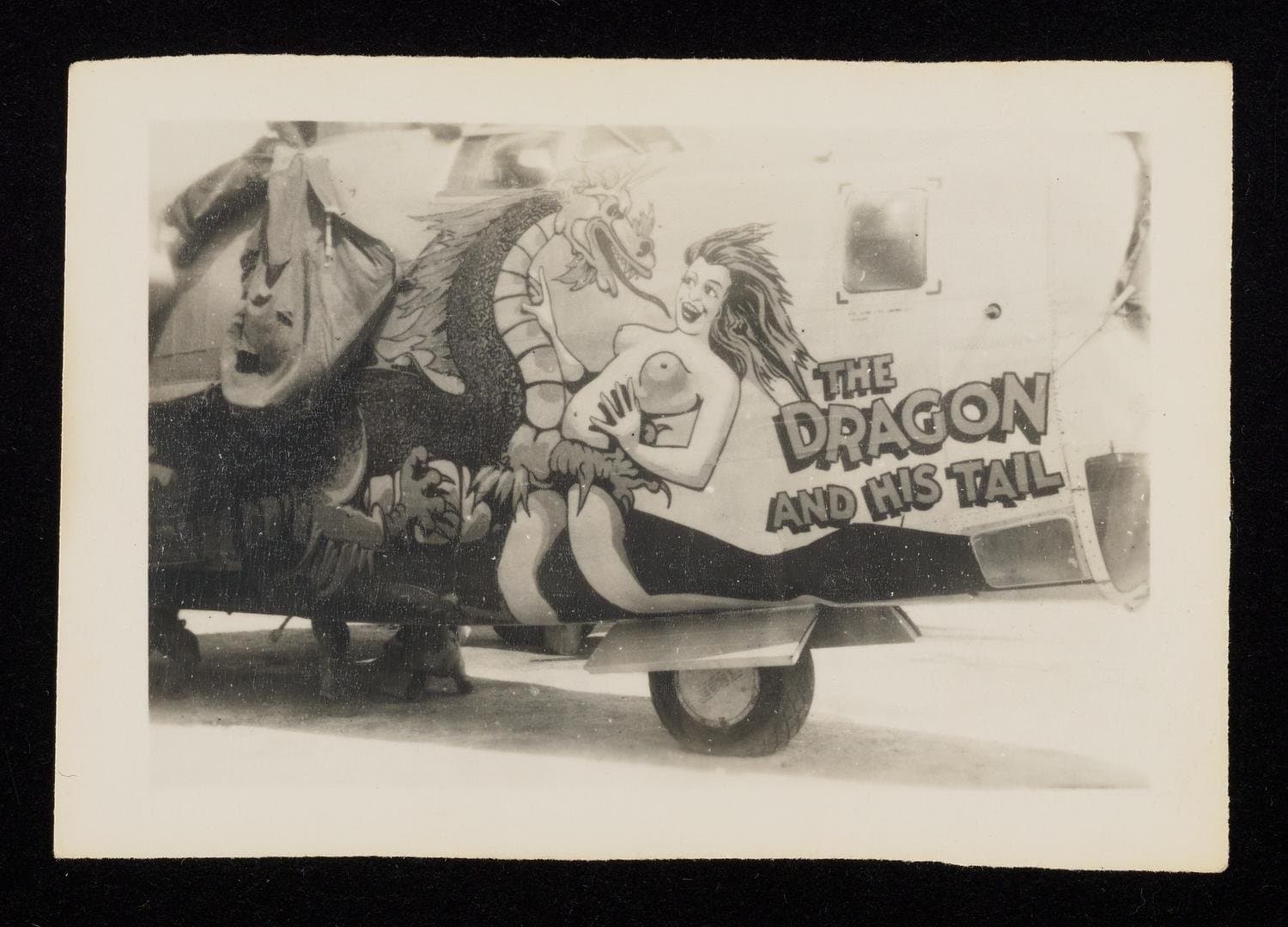
The Dragon and His Tail
The largest nose art in WWII, painted by a RISD-trained muralist. The workers at the scrapyard tried to save it. Nobody came.
Read the story →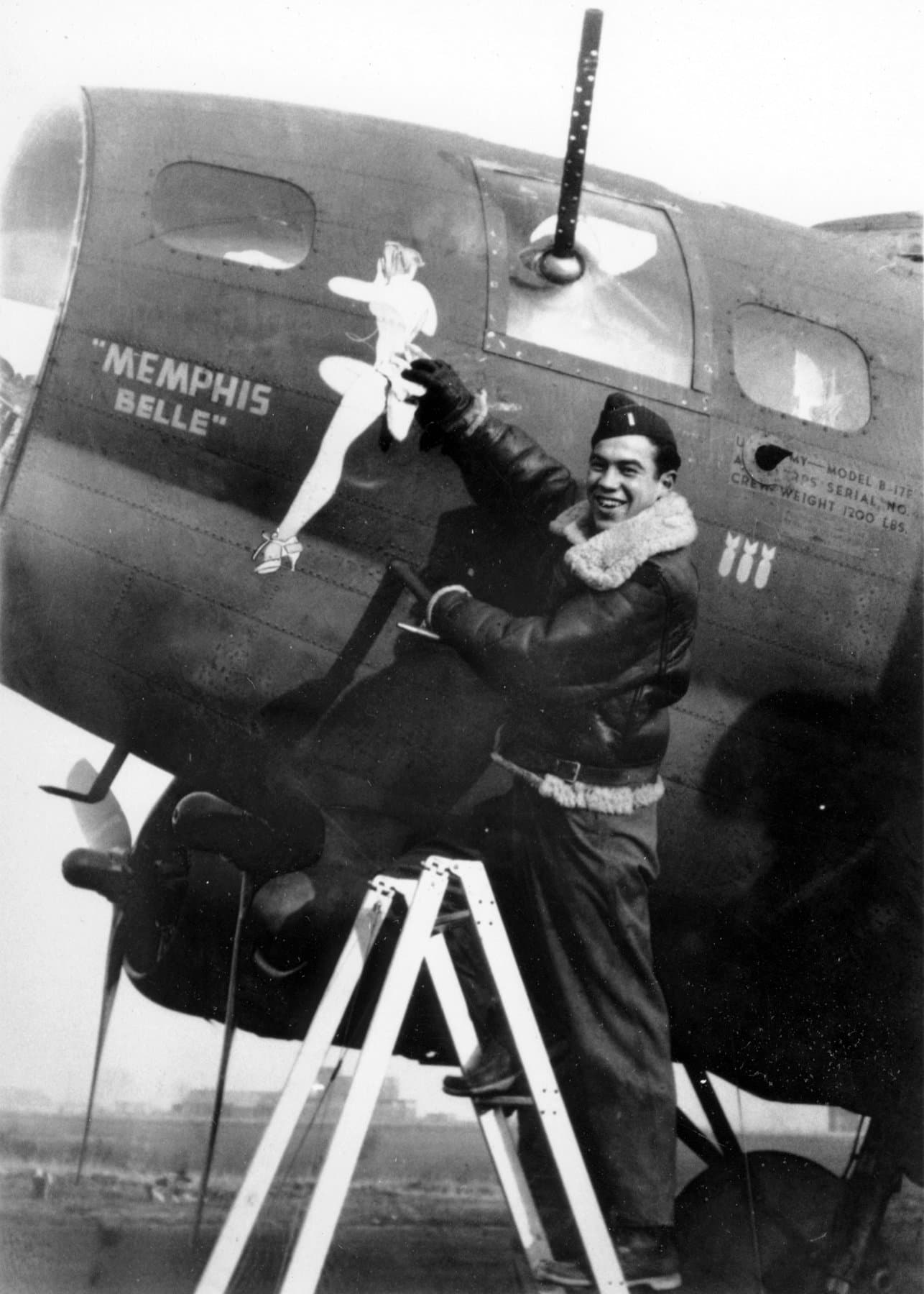
Memphis Belle
The most famous bomber of World War II carries a pin-up nobody posed for, painted by a mechanic who gave up art after the war.
Read the story →